
In the ever-evolving landscape of technology, quantum computing and artificial intelligence (AI) are at the forefront of innovation. Quantum computing, with its unparalleled computational power, is poised to revolutionize AI systems and unlock new possibilities. This article explores the convergence of quantum computing and AI, their complementarity, challenges, and exciting potential.
Key Takeaways:
- Quantum computing has the potential to revolutionize AI systems and unlock new possibilities.
- Quantum computers use qubits with the ability to exist in multiple states simultaneously.
- AI, powered by machine learning and deep learning, is driving transformative change across industries.
- The convergence of quantum computing and AI offers several benefits, including faster training of AI models and improved optimization.
- Promising applications of Quantum AI include drug discovery, financial modeling, supply chain optimization, and secure communication.
Quantum Computing: A Brief Overview
In the realm of computing, a new frontier is emerging that promises to revolutionize technology as we know it. Quantum computing, with its extraordinary capabilities, stands poised to unlock unprecedented computational power and open doors to hitherto unimaginable possibilities.
Unlike traditional computers that utilize binary bits to process information, quantum computers operate using quantum bits, or qubits. What sets qubits apart is their unique ability to exist in multiple states simultaneously, thanks to a phenomenon known as superposition.
Superposition allows qubits to represent not just 0s or 1s, like classical bits, but also any combination of 0 and 1. This expanded range of possibilities is what bestows quantum computers with their phenomenal computational power. The qubits’ states are further enhanced through a process called entanglement, where qubits become correlated and share information instantaneously, regardless of distance.
“Quantum computing can be seen as a new kind of computational substrate. It’s a fundamentally different way of doing computing.”
These unique properties of quantum computing enable quantum computers to perform complex calculations at astonishing speeds. While classical computers work sequentially, quantum computers harness parallelism, exponentially increasing their computational capacity.
The capabilities of quantum computing extend far beyond traditional computing realms. Quantum computers have the potential to revolutionize fields such as cryptography, optimization, materials science, and drug discovery. The ability to perform intricate calculations swiftly and accurately can accelerate advancements in these areas, thereby pushing the boundaries of human knowledge and innovation.
Quantum Computing: Confronting Complexity
The power of quantum computing lies in its ability to tackle computationally complex problems that are impractical or infeasible for classical computers to solve. These challenges encompass a wide range of computational tasks, including:
- Factoring large numbers for cryptography
- Optimizing complex systems and processes
- Solving intricate mathematical problems
- Simulating quantum mechanical phenomena
As the world stands on the precipice of the quantum revolution, it is vital for scientists, researchers, and industry pioneers to tap into the limitless potential of quantum computing. With its remarkable computational power, quantum computing promises to reshape industries, tackle global challenges, and propel humanity into an era of unprecedented progress and innovation.
The AI Revolution
Artificial intelligence (AI) is at the forefront of driving transformative change across industries. Powered by machine learning and deep learning, AI systems have the ability to analyze large datasets, recognize patterns, and make accurate predictions. However, these computational capabilities are currently limited by classical computers.
Quantum computing has the potential to overcome these limitations and take AI to a new level. With its advanced computational capabilities, quantum computing can enhance the speed and efficiency of AI algorithms, enabling faster processing of complex data sets and expanding the possibilities of AI applications.
“The combination of AI and quantum computing opens up exciting new avenues for innovation, discovery, and problem-solving,” says Dr. Rachel Thompson, a leading researcher in quantum AI at QuantumTech Corporation. “It has the potential to revolutionize industries such as healthcare, finance, and manufacturing, where AI-driven insights and optimization can have a significant impact.”
The integration of AI and quantum computing, also known as quantum AI, holds tremendous promise for solving complex problems that are currently beyond the reach of classical AI systems. Quantum algorithms can enhance AI’s ability to process and analyze vast amounts of data, enabling more accurate predictions and accelerating breakthroughs in various fields.
By harnessing the power of quantum computing, AI systems can address computational challenges that require substantial resources and time in traditional computing environments. This breakthrough has the potential to unlock new frontiers in AI research and development, fostering innovation and driving progress across industries.
To illustrate the potential impact of quantum AI, let’s explore a few key areas where this convergence can make a significant difference:
1. Drug Discovery
The field of drug discovery involves extensive data analysis, molecular simulations, and optimization processes. Quantum AI can accelerate these processes by enhancing the accuracy and speed of molecular simulations, enabling researchers to identify potential drug candidates more efficiently. This can revolutionize the development of new drugs, leading to faster treatment discoveries and improved patient outcomes.
2. Financial Modeling
AI is already revolutionizing the financial industry by automating tasks, detecting anomalies, and generating predictive insights. The integration of quantum computing in AI systems can further enhance their computational power, enabling more accurate predictions and risk assessments. This can help financial institutions optimize portfolios, manage risks, and make informed investment decisions.
3. Supply Chain Optimization
AI plays a vital role in optimizing supply chain operations, improving efficiency, reducing costs, and enhancing customer satisfaction. Quantum AI can enhance traditional AI algorithms by providing efficient solutions for complex optimization problems, such as route optimization, inventory management, and demand forecasting. This can help businesses streamline their supply chains, minimize costs, and deliver products more effectively.
4. Climate Modeling
Understanding and predicting complex climate systems is crucial for addressing climate change and developing sustainable strategies. Quantum AI can enhance climate modeling by empowering AI systems to analyze massive datasets and generate more accurate climate predictions. This can assist scientists and policymakers in making informed decisions and formulating effective climate change mitigation strategies.
5. Secure Communication
AI plays a vital role in developing encryption techniques and securing sensitive data. Quantum AI can strengthen data security by developing quantum-resistant encryption methods. These methods leverage the computational power of quantum computing to create secure communication channels that are robust against future quantum attacks, ensuring the confidentiality and integrity of sensitive information.
As the integration of quantum computing and AI continues to advance, the possibilities for innovation and discovery are staggering. Quantum AI has the potential to disrupt traditional industries, revolutionize research and development, and shape the future of technology. The collaboration between AI and quantum computing is poised to unlock new frontiers, enabling humanity to solve complex problems and create a better future.
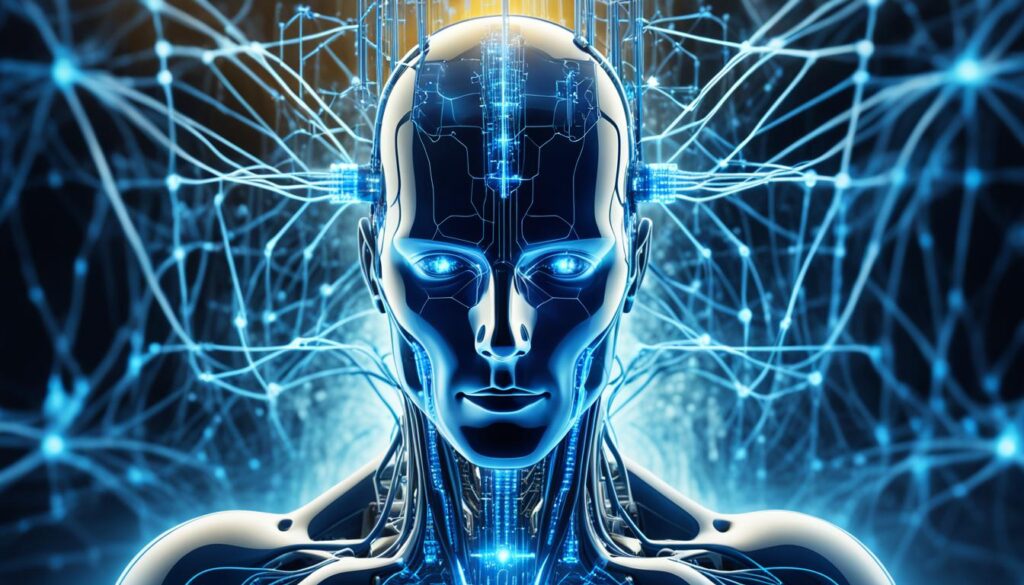
Benefits of the Quantum Computing and AI Synergy:
- Accelerated training of AI models
- Improved optimization of complex problems
- Development of quantum machine learning algorithms
- Generation of quantum datasets for AI applications
- Optimization of quantum computations by AI
Quantum AI Applications
The synergy between quantum computing and AI presents a world of exciting possibilities. Leveraging the power of quantum computing, various fields can benefit from innovative applications that have the potential to drive significant advancements. Let’s explore some of the remarkable Quantum AI applications:
1. Drug Discovery
In the field of healthcare, quantum computing can revolutionize the process of drug discovery. By leveraging its computational power, researchers can simulate and analyze complex molecular structures more efficiently, leading to the expedited development of new drugs and treatments. Quantum AI algorithms can assist in the identification of potential drug candidates and predict their efficacy with enhanced accuracy.
2. Financial Modeling
Quantum computing has the potential to transform financial modeling and risk management. Its ability to perform complex calculations at an unprecedented scale and speed allows for more accurate market predictions, portfolio optimization, and risk assessments. Quantum AI algorithms can further enhance financial analysis by uncovering intricate patterns and providing valuable insights for informed decision-making.
3. Supply Chain Optimization
The optimization of supply chains is vital for businesses to streamline operations and minimize costs. Quantum computing can leverage its computational capabilities to optimize supply chain networks by efficiently solving complex logistical challenges. Quantum AI algorithms can analyze large datasets, integrate real-time information, and optimize inventory management, production planning, and distribution strategies.
4. Climate Modeling
Climate change is a global challenge that demands innovative solutions. Quantum computing can revolutionize climate modeling by simulating complex climate systems with unparalleled precision. It can assist scientists in predicting weather patterns, modeling climate scenarios, and analyzing climate data more comprehensively. Quantum AI algorithms can facilitate the extraction of meaningful insights and contribute to the development of sustainable climate strategies.
5. Secure Communication
Quantum-resistant encryption methods are critical for ensuring secure communication in today’s digitally connected world. Quantum computing offers the potential to develop encryption algorithms that can withstand attacks from quantum computers, effectively protecting sensitive data. Quantum AI can contribute to the advancement of secure communication by developing encryption protocols that are resistant to quantum-based computational attacks.
These are just a few examples of the numerous Quantum AI applications. As quantum computing and AI continue to evolve, their integration is poised to unlock novel advancements and reshape the future of various industries. The potential for innovation and transformation is immense, and it is an exciting time to be at the forefront of this cutting-edge technology.
Challenges and Considerations
Despite the immense potential, the field of quantum computing and AI is not without its challenges and considerations. Overcoming these hurdles is essential to pave the way for greater advancements and harness the full power of this cutting-edge technology. Let’s explore some of the key challenges that researchers and developers face:
1. Quantum Computing Challenges
One of the primary challenges lies in developing practical quantum hardware that can reliably perform complex computations. Quantum computers rely on qubits, which are prone to errors caused by interference from environmental factors. Overcoming these hardware limitations is crucial to ensure the stability and scalability of quantum computing systems.
2. Algorithm Development
Creating quantum machine learning algorithms presents another significant hurdle. Traditional machine learning algorithms are not directly applicable to quantum computing, necessitating the development of new algorithms that can leverage the unique properties of quantum systems. This requires expertise in both quantum physics and machine learning techniques.
3. Data and Software Integration
Integrating quantum computing into existing data and software infrastructure poses challenges. Quantum computing requires specialized data encoding and processing techniques, and adapting existing software to work seamlessly with quantum systems can be complex. Developing quantum software libraries and tools that simplify the integration process is vital to the widespread adoption of quantum computing.
4. Error Correction
Errors are inherent in quantum systems due to various factors, such as noise and decoherence. Implementing error correction techniques is crucial to mitigate the impact of errors on computations. Error correction algorithms, coupled with robust fault-tolerant approaches, are essential to ensure the reliability and accuracy of quantum computing results.
5. Energy Consumption
Quantum computing systems require extremely low temperatures to maintain the delicate quantum states of qubits. This cooling process can be energy-intensive. As quantum computing advances and becomes more widely accessible, finding energy-efficient cooling solutions will be critical to reduce the environmental impact and operational costs associated with quantum computing.
6. Interdisciplinary Expertise
The successful development and implementation of quantum computing and AI technologies require diverse expertise from various scientific disciplines. Collaborations between experts in quantum physics, computer science, mathematics, and other fields are essential to address the complex challenges and push the boundaries of these innovative technologies.
Overcoming these challenges is key to realizing the full potential of quantum computing and AI. Researchers, scientists, and industry professionals across different domains are actively working together to develop solutions and drive progress in this exciting field.
Stay tuned to learn more about the road ahead and the future applications of quantum computing and AI.
The Road Ahead
The future of quantum computing and AI holds immense promise for technological innovation and advancement across various industries. As quantum computing technology continues to mature and become more accessible, it presents new opportunities for AI to address complex problems that were previously considered intractable.
With their combined potential, quantum computing and AI will reshape existing applications and unlock a world of new possibilities. Industries such as healthcare, finance, manufacturing, and transportation can expect significant advancements fueled by this convergence.
Technological Innovation and Advancements
The future of quantum computing and AI will bring forth remarkable technological innovations. Quantum computing’s ability to process vast amounts of data and perform complex calculations at unprecedented speeds will revolutionize AI systems. This will enable AI to extract deeper insights from massive datasets, enhancing decision-making and problem-solving capabilities.
Moreover, advancements in hardware and algorithms will allow quantum computing and AI to work in harmony, complementing each other’s strengths. This collaboration will lead to more efficient algorithms, optimized resource allocations, and improved performance across various applications.
Expanding Existing Applications
The synergy between quantum computing and AI will expand the capabilities of existing applications in remarkable ways. For instance, in healthcare, quantum computing can accelerate drug discovery processes, enabling the identification of novel therapies more rapidly and accurately than ever before.
In finance, quantum computing’s exceptional computational power can enhance risk assessment models, optimize asset allocation strategies, and enable faster and more precise market analysis. A more comprehensive understanding of complex financial systems can help generate insights that drive informed decision-making and reduce risks.
In the field of supply chain optimization, quantum computing’s ability to process large amounts of data quickly can help streamline operations, leading to improved efficiency, cost savings, and reduced environmental impact. This optimization can revolutionize logistics, inventory management, and distribution networks on a global scale.
Unlocking New Possibilities
The convergence of quantum computing and AI opens doors to entirely new domains and applications. Climate modeling, for example, can leverage quantum computing’s computational power to simulate complex climate systems, enhancing our understanding of climate change and facilitating the development of effective mitigation strategies.
Secure communication is another area where quantum computing and AI can work together to address current vulnerabilities. Quantum-resistant encryption techniques can be developed using AI algorithms and implemented on quantum computing platforms to ensure secure and private communication channels.
Moreover, the integration of quantum computing and AI can revolutionize natural language processing, recommendation systems, and autonomous robotics. This will empower machines to understand and interact with humans more effectively, transforming user experiences and enabling advancements in human-machine collaboration.
In conclusion, the future of quantum computing and AI is full of promise and excitement. Their convergence paves the way for technological breakthroughs, advancements in existing applications, and the exploration of new possibilities across various industries. As we continue to push the boundaries of innovation and collaboration, the future holds great potential for quantum computing and AI to shape a more efficient, sustainable, and transformative world.
Environmental Sustainability and Responsible Development
In the era of advanced technologies, it is imperative to prioritize environmental sustainability and responsible development. As humanity embraces the potential of quantum computing and other advanced technologies, it is crucial to ensure that their implementation aligns with sustainable practices.
One key area that requires attention is renewable energy. By harnessing sustainable energy sources such as solar, wind, and hydroelectric power, we can mitigate the environmental impact of these technologies. Investing in renewable energy not only reduces carbon emissions but also promotes energy efficiency and long-term sustainability.
Eco-friendly manufacturing processes
Responsible development also entails adopting eco-friendly manufacturing processes. By incorporating sustainable practices into manufacturing, we can minimize waste, conserve resources, and reduce pollution. This includes using recycled materials, implementing energy-efficient systems, and promoting circular economy principles.
Sustainable practices for responsible development
Implementing sustainable practices across all stages of development is essential. This includes careful consideration of resource consumption, waste management, and carbon footprint. By adopting sustainable practices, we can ensure that the benefits of advanced technologies do not come at the expense of our planet’s well-being.
Environmental sustainability and responsible development should be at the core of every technological advancement. It is our responsibility to create a sustainable future for generations to come.
By prioritizing environmental sustainability and responsible development, we can pave the way for a brighter and more sustainable future. Innovations in renewable energy, eco-friendly manufacturing processes, and sustainable practices are key to minimizing the environmental impact of quantum computing and other advanced technologies.
Together, we can harness the power of technology while safeguarding the health and longevity of our planet.
Conclusion
In conclusion, the future of advanced technologies such as quantum computing and AI is brimming with possibilities. The key to harnessing this potential lies in collaboration, innovation, and responsible governance. By working together, we can unlock new frontiers of knowledge and push the boundaries of what is possible.
Collaboration allows for the exchange of ideas, expertise, and resources, fostering breakthroughs in future technologies. It brings together diverse perspectives, amplifying innovation and inspiring groundbreaking solutions to complex challenges.
As we move forward, responsible governance is crucial in ensuring that these technologies are used ethically and for the benefit of all. By establishing frameworks that prioritize inclusivity, privacy, and security, we can build a future that is not only technologically advanced, but also sustainable and equitable.
The choices we make today will shape the trajectory of humanity for generations to come. Let us embrace the potential of future technologies, collaborate with one another, foster innovation, and govern responsibly. Together, we can create a future that is powered by human ingenuity, while also being mindful of our collective responsibilities to society and the planet.
FAQ
What is quantum computing?
Quantum computing is a type of computing that utilizes qubits, which can exist in multiple states simultaneously, to perform computations exponentially faster than traditional computers.
How does quantum computing complement AI?
Quantum computing has the potential to enhance AI by speeding up the training of AI models, improving optimization problems, inspiring the development of new machine learning algorithms, and generating quantum datasets for AI applications.
What are the applications of quantum computing and AI?
The convergence of quantum computing and AI has promising applications such as accelerating drug discovery, revolutionizing financial modeling, optimizing supply chains, simulating climate systems, and enhancing secure communication through quantum-resistant encryption methods.
What are the challenges in quantum computing and AI?
Some challenges in quantum computing and AI include developing practical quantum hardware, creating quantum machine learning algorithms, addressing data and software requirements, implementing error correction techniques, reducing energy consumption, and fostering interdisciplinary collaboration.
What is the future of quantum computing and AI?
The future of quantum computing and AI holds immense potential for technological innovation. As quantum computing matures and becomes more accessible, it will empower AI to tackle previously intractable problems, advancing existing applications and paving the way for new possibilities.
How can environmental sustainability be ensured in the development of advanced technologies?
It is crucial to prioritize environmental sustainability and responsible development. Innovations in renewable energy, eco-friendly manufacturing processes, and sustainable practices are essential to minimize the environmental impact of quantum computing and other advanced technologies.
What is the importance of collaboration, innovation, and responsible governance in shaping the future of advanced technologies?
Collaboration, innovation, and responsible governance are key factors in shaping a technologically advanced, sustainable, inclusive, and enriched future. Choices made today in the realm of quantum computing and AI will have a profound impact on future generations.
Source Links
- https://medium.com/@NorthStarLight/navigating-the-next-frontier-the-future-of-ai-machine-learning-quantum-computing-and-advanced-3102941282fe
- https://www.linkedin.com/pulse/quantum-computing-ai-next-frontier-jershin-j-m-eqgxf
- https://www.linkedin.com/pulse/quantum-computing-next-frontier-advanced-technologies-informics