
Quantum computing, a revolutionary technology, holds the potential to transform artificial intelligence (AI) and usher in an era of unrivaled computational power. As Moore’s Law, which predicted exponential growth in transistor density, approaches its physical limitations, the exploration of quantum computing has become crucial.
Quantum computing operates on qubits, which can exist in superposition and be entangled, allowing for the execution of complex algorithms exponentially faster than classical computers. This has profound implications for AI development, enabling deep learning models to achieve unprecedented levels of accuracy and efficiency.
Key Takeaways
- Quantum computing has the potential to revolutionize AI development by providing unprecedented computational power.
- Quantum computers operate on qubits, which can exist in superposition and be entangled, enabling exponential speed-up for complex algorithms.
- Deep learning models in AI can achieve higher accuracy and efficiency with the utilization of quantum computing.
- Moore’s Law, which predicted exponential growth in transistor density, is reaching its physical limitations, making quantum computing exploration crucial.
- The convergence of quantum computing and AI opens up new possibilities for advancements in various industries.
Quantum Computing: A Paradigm Shift in Computation
Quantum computing operates on the principles of quantum mechanics, utilizing qubits that can exist in a superposition of states, representing both 0 and 1 simultaneously. This phenomenon, known as quantum superposition, allows for the execution of complex algorithms at exponentially faster speeds. Qubits can also be entangled, allowing them to share information instantaneously, regardless of distance, a property referred to as quantum entanglement. This unique characteristic of quantum computing has the potential to revolutionize various fields, including cryptography, optimization simulation, and machine learning.
Quantum computers leverage quantum information to perform calculations and solve problems that are beyond the reach of classical computers. Unlike classical bits, which can represent only one state at a time (either 0 or 1), qubits exist in a superposition of states. This means that a qubit can be in both states simultaneously, exponentially expanding the computational possibilities. Quantum algorithms harness this feature to solve complex problems more efficiently, offering a significant advantage over classical computing methods.
The power of quantum computing lies in its ability to utilize quantum superposition and entanglement to process information. Quantum superposition allows qubits to simultaneously represent multiple states, enabling the parallel execution of operations. This parallelism enables quantum computers to process vast amounts of data in a fraction of the time required by classical computers. Quantum entanglement, on the other hand, allows qubits to be correlated to one another, even when physically separated. This property enables the instantaneous exchange of information between qubits, enabling faster communication and computation.
Quantum computing’s ability to achieve exponential speedup and solve complex problems has the potential to revolutionize various fields. In cryptography, quantum computers can break traditional encryption algorithms, prompting the need for quantum-resistant encryption methods. Quantum optimization algorithms also have applications in logistic optimization, supply chain management, and financial portfolio optimization. Additionally, quantum machine learning algorithms offer advancements in pattern recognition, data analysis, and artificial intelligence tasks.
Quantum computing represents a paradigm shift in computation, unlocking new frontiers and pushing the boundaries of what is possible. The combination of quantum superposition and entanglement offers the potential for unprecedented computational capabilities, transforming the way we solve problems and process information.
Quantum Computing in Action: Quantum Algorithms
Quantum algorithms leverage the unique properties of qubits to solve complex problems more efficiently than classical algorithms. Some notable quantum algorithms include:
- Grover’s Algorithm: An algorithm that can efficiently search unsorted databases, providing a quadratic speedup compared to classical methods.
- Shor’s Algorithm: A quantum algorithm that can factor large numbers exponentially faster than any known classical algorithm, threatening current encryption methods.
- Quantum Machine Learning Algorithms: Quantum algorithms designed to enhance machine learning tasks, such as classification, clustering, and regression.
These quantum algorithms demonstrate the potential of quantum computing to tackle problems that are currently intractable for classical computers. As research and development continue to advance, quantum computing is poised to reshape industries and enable groundbreaking advancements in various fields.
As illustrated in the image above, quantum computing opens up new horizons for computational power and problem-solving capabilities. With its unique ability to operate on quantum information, quantum computing is driving innovation and revolutionizing traditional computation methods.
| Quantum Computing | Classical Computing |
|---|---|
| Utilizes qubits that can exist in a superposition of states. | Relies on classical bits that can represent only one state at a time. |
| Processes vast amounts of data in parallel, leading to exponential speedup. | Processes data sequentially, resulting in slower computations for complex problems. |
| Utilizes quantum entanglement for instant information exchange between qubits. | Relies on traditional communication methods for data exchange. |
| Has the potential to solve complex problems in cryptography, optimization, and machine learning more efficiently. | Constrained by the limitations of classical algorithms for solving complex problems. |
The table above provides a comparison between quantum computing and classical computing, emphasizing the unique advantages offered by quantum systems.
Quantum-Enhanced AI: A Game-Changer for Various Industries
The convergence of quantum computing and AI has the potential to catalyze breakthroughs in numerous industries. By harnessing quantum computing’s unparalleled processing power, AI algorithms can tackle challenges that are intractable for classical computers.
In the healthcare industry, quantum computing can accelerate drug discovery by simulating molecular interactions and analyzing patient data for personalized medicine. Quantum-enabled AI models can process vast amounts of genomic and clinical data, identifying potential drug targets and predicting treatment outcomes with greater accuracy and efficiency.
In finance, quantum-enhanced AI can revolutionize risk assessment, portfolio optimization, and fraud detection. Quantum algorithms can process large datasets, optimize investment strategies, and identify patterns indicative of fraudulent activities. The computational power of quantum computing enables faster simulations and analysis, leading to more informed financial decisions.
Quantum computing also holds tremendous potential for materials science. By leveraging the principles of quantum mechanics, scientists can design materials with superior properties suitable for energy storage, transportation, and manufacturing. Quantum-enabled AI algorithms can predict the behavior of complex materials, allowing researchers to optimize their composition and performance for various applications.
Quantum-enhanced AI has the capacity to reshape industries by solving problems that were once deemed unsolvable, catapulting advancements in healthcare, finance, and materials science.”
Advantages of Quantum-Enhanced AI:
- Processing vast amounts of healthcare data for personalized medicine
- Optimizing investment strategies and risk assessment in finance
- Designing materials with superior properties for various applications
| Industry | Applications |
|---|---|
| Healthcare | Drug discovery, personalized medicine |
| Finance | Risk assessment, portfolio optimization, fraud detection |
| Materials Science | Designing new materials for energy storage, transportation, and manufacturing |
By combining quantum computing and AI, businesses have the opportunity to unlock new insights, drive innovation, and gain a competitive edge in their respective industries. The potential benefits of quantum-enhanced AI are vast and far-reaching, paving the way for transformative advancements that were once unimaginable.
Challenges and Opportunities on the Quantum Frontier
While the promise of quantum computing is undeniable, it is not without its challenges. Building and maintaining quantum computers involves navigating complex systems that come with their own set of obstacles. From a technical standpoint, quantum systems are highly susceptible to errors and decoherence, which can compromise the accuracy of calculations. Additionally, these systems require significant financial investments in research and development to improve quantum error correction, qubit coherence times, and temperature control.
However, despite these challenges, the opportunities that quantum computing presents cannot be ignored. The potential rewards are immense, leading to transformative advancements in various industries that can benefit from unparalleled computational power. By leveraging the unique properties of quantum systems, such as superposition and entanglement, quantum computers hold the key to solving complex problems that are beyond the reach of classical computers.
Challenges in Quantum Computing
One of the primary challenges in quantum computing is the high error rates experienced by quantum systems. Quantum bits, or qubits, are highly sensitive to noise and external interference, making it difficult to maintain the delicate quantum states required for accurate computations. Additionally, qubits are subject to decoherence, a phenomenon where their quantum states degrade over time. This makes it crucial to develop robust error correction techniques and improve the coherence times of qubits to ensure the reliability of quantum systems.
Investments in Research and Development
To overcome these challenges, substantial investments in research and development are needed. Scientists and engineers around the world are collaborating to improve quantum error correction algorithms, explore novel qubit designs, and develop innovative methods to control temperature and reduce environmental interference. These efforts aim to enhance the stability and scalability of quantum systems, bringing us closer to the realization of practical quantum computers.
“The potential of quantum computing is so vast that it warrants the investment of resources and expertise to overcome the current challenges. By addressing the limitations of quantum systems, we can unlock a new era of technology and innovation.”
Opportunities for Advancement
Despite these challenges, the potential applications of quantum computing are vast and far-reaching. Industries such as healthcare, finance, and materials science stand to benefit greatly from the computational power of quantum computers. For example, in healthcare, quantum computing can revolutionize drug discovery by simulating molecular interactions and analyzing vast amounts of patient data for more personalized treatments. In finance, quantum computing can provide faster and more accurate risk assessments, portfolio optimizations, and fraud detection. Additionally, in materials science, quantum computing can expedite the development of new materials with enhanced properties for various applications.
To get a glimpse of the immense potential of quantum computing, let’s take a look at the table below, which highlights some of the industries and their specific challenges where quantum computing can make a significant impact:
| Industry | Challenges | Potential Quantum Computing Solutions |
|---|---|---|
| Healthcare | Drug discovery, personalized medicine | Simulating molecular interactions, analyzing patient data for personalized treatments |
| Finance | Risk assessment, portfolio optimization, fraud detection | Faster and more accurate algorithms for risk analysis and fraud detection |
| Materials Science | Designing new materials with enhanced properties | Simulating material properties for improved energy storage, transportation, and manufacturing |
While challenges lie ahead, the future of quantum computing is filled with immense potential. With continued investments in research and development, we are paving the way for a new era of technology and innovation that could redefine the limits of computational power.
The End of Moore’s Law and the Rise of Quantum Computing
Moore’s Law, the famous observation predicting exponential growth in transistor density, is facing a critical juncture due to the miniaturization of silicon-based transistors. As transistors shrink to the nanometer scale, they encounter quantum mechanical effects and other physical limitations, making further exponential growth in transistor density increasingly challenging.
However, the emergence of quantum computing offers a potential solution to sustain the momentum of computational growth beyond Moore’s Law. Quantum computing leverages alternative materials and innovative computing paradigms to unleash the full power of quantum mechanics. Materials like graphene and molybdenite allow researchers to explore new avenues for building quantum computers based on principles that differ from traditional silicon-based transistor miniaturization.
By harnessing the unique properties of quantum systems, such as superposition and entanglement, quantum computing holds the potential to revolutionize computing power and overcome the physical limitations encountered in silicon-based systems. Quantum computers can manipulate qubits, which represent both 0 and 1 simultaneously, enabling the execution of complex algorithms exponentially faster than classical computers.
As the limitations of Moore’s Law become more evident, the rise of quantum computing represents a paradigm shift in the world of computation. It presents new opportunities for researchers and engineers to explore innovative ways of achieving computational advancements that surpass the capabilities of classical computing.
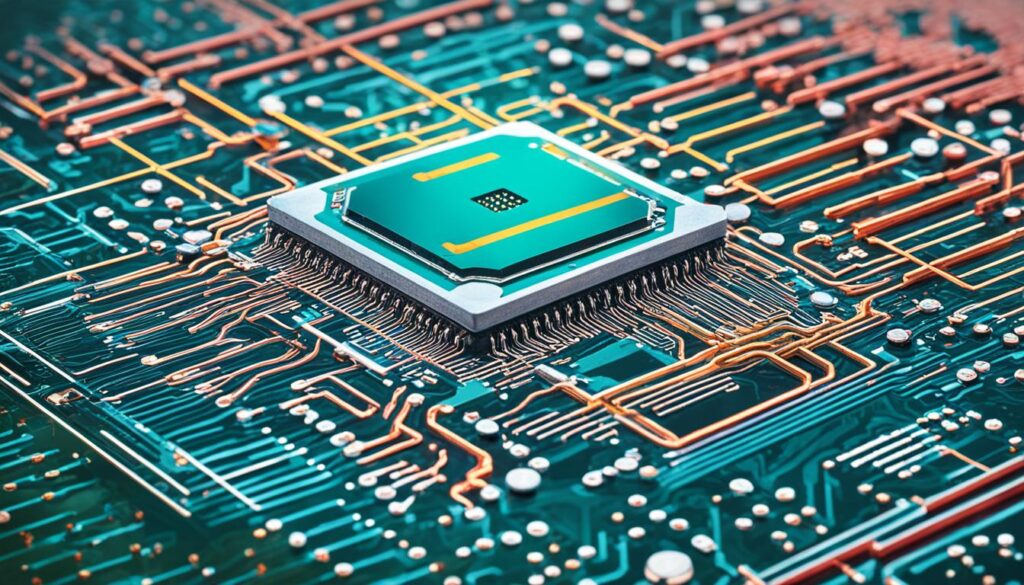
“Quantum computing is poised to change the world of computation by leveraging the fundamental principles of quantum mechanics, ushering in a new era of unprecedented computational power.”
With the potential to solve complex problems that are currently computationally intractable, quantum computing holds promise not only for the scientific community but also for industries such as healthcare, finance, and materials science. The ability to simulate molecular interactions in drug discovery, optimize portfolio strategies in finance, and design new materials for various applications is within reach with the advent of quantum computing.
The end of Moore’s Law signifies a turning point in computing history, where the limitations of silicon-based transistor miniaturization are superseded by the immense potential of quantum computing. Researchers and industry leaders are actively investing in quantum technologies to rise above the limitations of traditional computing and unlock the full potential of quantum mechanics for the next generation of computational power.
Quantum Computing: A Paradigm Shift in Computing Units
Quantum computing represents a paradigm shift from classical computing, operating on bits, to quantum computing, operating on qubits. Unlike classical computers that operate on binary bits (0 or 1), qubits can exist in a quantum superposition of states, representing both 0 and 1 simultaneously. This quantum superposition enables exponential processing speed for complex algorithms. Additionally, qubits can be entangled, allowing for instant information sharing, regardless of distance.
Quantum computing’s unique computing units redefine the limits of computational power and offer new possibilities for solving complex problems. By harnessing the principles of quantum superposition and quantum entanglement, quantum computers have the potential to solve problems that are currently intractable for classical computers. The ability to process vast amounts of data simultaneously and to instantly share information through entanglement opens up a new frontier of computing possibilities.
“Quantum computing represents a breakthrough in computing units, offering the potential for exponential processing power and unparalleled computational capabilities.”
The impact of quantum computing extends far beyond traditional computing applications. Industries such as finance, healthcare, and materials science stand to benefit greatly from the power of quantum computing. For example, in finance, quantum computing can revolutionize risk assessment and portfolio optimization, enabling more accurate predictions and informed decision-making. In healthcare, quantum computing can accelerate drug discovery by simulating complex molecular interactions. In materials science, quantum computing can facilitate the design of advanced materials with superior properties for various applications.
The Quantum Supremacy Race
The race for achieving quantum supremacy is underway, with major technology companies and research institutions competing to develop scalable and fault-tolerant quantum computing systems. Achieving quantum supremacy means demonstrating the ability of a quantum computer to solve a problem that is currently infeasible for classical computers, showcasing the true power of quantum computing.
While quantum computers are still in their early stages of development, significant progress has been made in recent years. Researchers are working on reducing error rates and improving qubit coherence to enable more stable and reliable quantum computations. Overcoming these challenges is crucial for the practical implementation of quantum computing on a larger scale.
In conclusion, quantum computing represents a seismic shift in computing units, leveraging the concepts of quantum superposition and quantum entanglement to redefine computational power. As researchers continue to push the boundaries of quantum computing, the potential applications and advancements are vast. The future holds the promise of revolutionary breakthroughs that will shape various industries and drive innovation to new frontiers.
Quantum Computing: Overcoming Challenges for Future Growth
Building and maintaining quantum computers present significant challenges. Quantum systems are sensitive to environmental interference, leading to decoherence and errors in qubit states. Overcoming these challenges requires advancements in quantum error correction algorithms, maintaining qubit coherence, and controlling temperature.
Governments, academia, and industry are heavily investing in research and development efforts to address these challenges and harness the transformative power of quantum computing for future growth.

Quantum Error Correction: Ensuring Reliable Computations
One of the primary challenges in quantum computing is the susceptibility of qubits to errors caused by environmental disturbances. Quantum error correction (QEC) algorithms are designed to counteract the effects of noise and errors, thereby enhancing the reliability and accuracy of quantum computations. Implementing effective QEC techniques is crucial for the successful operation of quantum computers.
Qubit Coherence: Preserving Quantum States
Qubit coherence refers to the ability of qubits to maintain their quantum states over a desired period. Decoherence, caused by interactions with the environment, leads to the loss of information and hampers the reliability of quantum computations. Extending qubit coherence times is a critical area of research, as it directly impacts the performance and scalability of quantum computers.
Temperature Control: Managing Quantum Systems
Strict temperature control is essential for ensuring the stability and efficacy of quantum systems. Fluctuations in temperature can introduce noise and disrupt qubit states, interfering with the accuracy of calculations. Developing effective cooling and temperature control mechanisms is vital for maintaining the integrity of quantum computations and maximizing the performance of quantum computers.
“The challenges of quantum computing underscore the need for robust quantum error correction techniques, qubit coherence improvement, and precise temperature control to unlock the true potential of this revolutionary technology.”
Quantum Computing and Neuromorphic Computing: Shifting Computing Paradigms
Alongside quantum computing, neuromorphic computing represents a shift in computing paradigms. While quantum computing focuses on utilizing quantum phenomena to redefine computation, neuromorphic computing aims to emulate the computational efficiency of the human brain by leveraging principles of computational neuroscience.
Neuromorphic computing involves the development of computing systems that mimic neural networks found in the human brain. By mimicking the behavior and structure of neural networks, these systems can perform tasks inspired by the brain’s information processing capabilities.
One key approach in neuromorphic computing is the use of spiking neural networks, which model the behavior of individual neurons and their interactions. These networks operate based on the timing and synchronization of spikes, allowing for efficient and adaptive computations.
Additionally, neuromorphic computing makes use of memristive devices that exhibit properties similar to synapses in the human brain. These devices can learn and adapt their behavior based on the input they receive, enabling dynamic changes in synaptic strength.
Furthermore, on-chip learning algorithms are employed in neuromorphic computing to optimize the interaction between the computational units. This approach allows for efficient processing of large quantities of data, making it suitable for tasks such as pattern recognition, classification, and optimization.
“The convergence of quantum and neuromorphic computing opens up new avenues for transformative advancements in AI and computational capabilities.”
This convergence of quantum and neuromorphic computing presents exciting opportunities for the development of efficient and adaptive computing systems. Integrating quantum computing’s computational power and neuromorphic computing’s ability to emulate the brain’s efficiency can lead to significant breakthroughs in various fields.
In the realm of artificial intelligence, this combination can enable the development of more sophisticated neural networks that can process and analyze complex data sets with enhanced efficiency and accuracy. By leveraging quantum computing’s computational prowess and neuromorphic principles, these systems can surpass traditional AI models in terms of computational efficiency and learning capabilities.
Moreover, the integration of quantum and neuromorphic computing holds promise for addressing real-world challenges. For example, in robotics, the combination of quantum and neuromorphic computing can enable the development of more advanced autonomous systems that can adapt to changing environments and perform complex tasks with greater efficiency.
| Quantum Computing | Neuromorphic Computing |
|---|---|
| Utilizes qubits for quantum information processing. | Mimics neural networks to perform brain-inspired computations. |
| Relies on quantum superposition and entanglement. | Built on spiking neural networks and memristive devices. |
| Offers exponential computational power. | Provides efficient and adaptive computing capabilities. |
| Enables complex quantum algorithms and simulations. | Emulates the computational efficiency of the human brain. |
This convergence of quantum and neuromorphic computing represents a compelling shift in computing paradigms, combining the power of quantum computing with the efficiency of brain-inspired processing. As research in these areas progresses, we can expect transformative advancements in AI, computational capabilities, and a new wave of innovation across various domains.
Conclusion
Quantum computing represents a paradigm shift in computation that has the potential to revolutionize AI development and redefine the limits of computational power. By harnessing the power of qubits and quantum algorithms, quantum computers offer unprecedented computational capabilities. This opens up possibilities for faster and more efficient processing of complex algorithms, paving the way for groundbreaking advancements in AI technologies.
Although there are challenges involved in building and maintaining quantum systems, the potential impact on various industries such as healthcare, finance, and materials science is immense. Quantum computing can accelerate drug discovery in healthcare, enhance risk assessment and fraud detection in finance, and revolutionize materials science for energy storage and manufacturing.
The end of Moore’s Law, with its limitations on silicon-based transistor miniaturization, paves the way for the rise of quantum computing. As Moore’s Law reaches its physical boundaries, quantum computing offers a promising solution to sustain the momentum of computational growth. It marks the beginning of a new era of computational supremacy, where AI development and other industries can leverage the immense power of quantum computing to drive innovation and achieve previously unimaginable breakthroughs.
FAQ
What is quantum computing?
Quantum computing is a revolutionary technology that operates on qubits, which can exist in superposition and be entangled. This allows for the execution of complex algorithms exponentially faster than classical computers.
How does quantum computing impact AI development?
Quantum computing offers unparalleled computational power, enabling AI algorithms to tackle challenges that are intractable for classical computers. This can lead to breakthroughs in various industries, such as healthcare, finance, and materials science.
What are the challenges in building and maintaining quantum computers?
Quantum systems are expensive to develop and are susceptible to errors and decoherence. Overcoming these challenges requires advancements in quantum error correction, qubit coherence, and temperature control.
What is the relationship between quantum computing and Moore’s Law?
As Moore’s Law reaches its physical limitations with the miniaturization of silicon-based transistors, quantum computing offers a potential solution to sustain the momentum of computational growth beyond Moore’s Law.
How is quantum computing different from classical computing?
Quantum computing operates on qubits, which can exist in a superposition of states, representing both 0 and 1 simultaneously. This quantum superposition enables exponential processing speed for complex algorithms, unlike classical computers that operate on binary bits.
How can quantum computing overcome its challenges for future growth?
Overcoming challenges in quantum computing requires advancements in quantum error correction algorithms, maintaining qubit coherence, and controlling temperature. Investments in research and development are essential to harness the transformative power of quantum computing.
What is neuromorphic computing?
Neuromorphic computing emulates the computational efficiency of the human brain by leveraging principles of computational neuroscience. It offers the potential for efficient and adaptive computing systems by mimicking neural networks and utilizing spiking neural networks, memristive devices, and on-chip learning algorithms.
What is the impact of quantum computing on AI development and computational power?
Quantum computing’s unparalleled computational power and ability to execute complex algorithms at exponential speeds redefine the limits of AI development and computational capabilities, marking a new era of technological advancement.