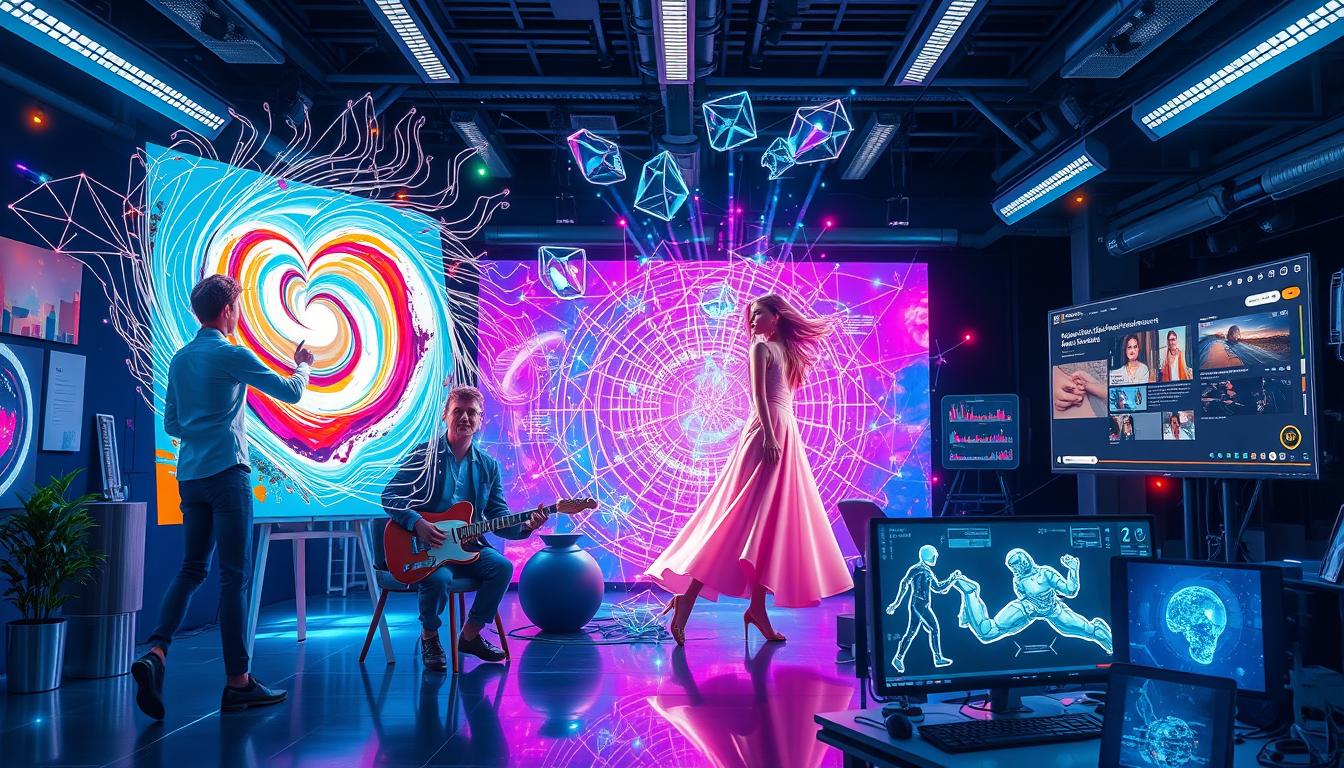
Generative AI is reshaping our world, pushing the limits of creativity and innovation. This groundbreaking technology uses advanced machine learning to produce new content, from text to images and music1.
Unlike traditional AI that analyzes existing data, generative AI creates entirely new content. It’s changing how we approach art, business, and scientific research. The impact of this technology spans various sectors, offering fresh perspectives and solutions.
Introduced in 2014, Generative Adversarial Networks (GANs) have become a cornerstone of this field. They work alongside other models like Variational Autoencoders (VAEs) and OpenAI’s GPT to drive innovation2.
From visual arts to healthcare, generative AI is making waves. It’s speeding up drug discovery, enhancing marketing strategies, and even composing music. This technology is not just a tool; it’s a partner in the creative process13.
As we embrace generative AI, we face new challenges. These include quality control, ethical concerns, and data privacy issues. Yet, the potential for transformation across industries remains immense2.
Key Takeaways
- Generative AI creates new content using machine learning
- It impacts various sectors from art to scientific research
- GANs, VAEs, and GPT are key technologies in this field
- Applications range from drug discovery to music composition
- Challenges include ethical concerns and quality control
What is Generative AI?
Generative AI represents a groundbreaking shift in machine learning. It’s a technology that creates new content rather than just predicting from existing datasets4. This innovative approach has sparked a revolution in AI creativity, leading to remarkable advancements in text generation, image synthesis, and other creative fields.
Definition and Overview
At its core, generative AI uses large language models to produce original content. These models, trained on vast amounts of data, can generate text, images, and even music that closely mimics human-created work4. The technology has evolved rapidly, with models like ChatGPT boasting billions of parameters and trained on massive internet text datasets4.
Key Technologies Behind Generative AI
Several key technologies power generative AI:
- Generative Adversarial Networks (GANs)
- Variational Autoencoders (VAEs)
- Transformer architecture
These technologies enable AI to convert inputs into numerical representations, or tokens, opening up a wide range of applications4. From creating synthetic image data to designing novel protein structures, generative AI is pushing the boundaries of what’s possible.
Examples of Generative AI in Action
Generative AI is making waves across industries:
| Application | Example | Impact |
|---|---|---|
| Text Generation | GPT-3 | Produces credible writing in seconds5 |
| Image Creation | DALL·E | Generates unique images from text descriptions |
| Music Composition | MuseNet | Creates original musical pieces |
These applications demonstrate the versatility of generative AI, showcasing its potential to transform creative processes across various domains. As the technology continues to evolve, we can expect even more innovative uses of generative AI in the future.
The Historical Context of Generative AI
Generative AI has a rich history dating back to the dawn of artificial intelligence. The field emerged in the 1960s, with early chatbots paving the way for future innovations678. This journey through time reveals how natural language processing, deep learning, and the quest for artificial general intelligence have shaped the landscape of AI.
Milestones in AI Development
The 1950s marked the birth of AI, with groundbreaking inventions like the Perceptron in 19576. ELIZA, created in 1961, became a pioneer in natural language processing67. The 1970s saw advancements in facial recognition and the introduction of backpropagation6. Despite facing an AI winter from 1973 to 1979, machine learning continued to evolve6.
Evolution of Creative AI Tools
The journey of creative AI tools gained momentum in the 2000s. In 2006, Restricted Boltzmann Machines set the stage for deep learning breakthroughs7. The introduction of Generative Adversarial Networks (GANs) in 2014 revolutionized image synthesis and music composition67. By 2022, text-to-image models and AI-powered coding assistants like GitHub’s Copilot gained widespread adoption7.
Significant Case Studies
Recent years have seen remarkable advancements in generative AI. The GPT models, introduced by OpenAI in 2018, marked a significant breakthrough in natural language processing8. In 2022, companies like Stability AI and Jasper achieved unicorn status, showcasing the industry’s rapid growth7. These developments have sparked discussions about AI’s impact on creative jobs and copyright concerns7.
| Year | Milestone | Impact |
|---|---|---|
| 1957 | Perceptron invented | First trainable neural network |
| 1961 | ELIZA created | Pioneer in natural language processing |
| 2014 | GANs introduced | Revolution in image synthesis |
| 2018 | GPT models launched | Breakthrough in language generation |
How Generative AI is Impacting the Creative Arts
Generative AI is revolutionizing the creative arts, offering new tools and possibilities for artists across various disciplines. The technology’s impact is evident in music, visual arts, and writing, pushing the boundaries of traditional creativity.
Music Composition and AI
In the realm of music, AI models are changing the landscape of composition. These tools can create original pieces and mimic various styles, opening up new avenues for musicians and composers. The integration of machine learning in music creation allows for unique collaborations between human artists and AI systems9.
AI in Visual Art Creation
Visual arts have seen a significant transformation with the advent of AI tools. These systems enable the creation of unique artworks and designs, blending traditional techniques with cutting-edge technology. Artists are now exploring new forms of expression by leveraging natural language processing to generate visual content10.
Innovations in Writing and Storytelling
In the world of writing, AI is making waves by assisting with story ideas, article drafting, and interactive content creation. This technology is not only enhancing productivity but also inspiring new forms of storytelling. The symbiotic relationship between human creativity and AI has led to innovative outcomes in creative writing11.
As generative AI continues to evolve, it’s clear that its impact on the creative arts is profound and far-reaching. While concerns about job displacement exist, many experts argue that AI is more likely to augment human creativity rather than replace it. Educational institutions are already exploring ways to incorporate AI into creative curriculums, preparing the next generation of artists for a technology-driven future11.
“Generative AI can assist in promoting divergent thinking to enhance creativity.”
The emergence of generative AI in the arts has sparked important discussions about copyright, ownership, and the originality of AI-generated content. As this technology continues to develop, it will be crucial to address these concerns while embracing the new possibilities it offers to the creative world11.
Applications of Generative AI in Business
Generative AI is revolutionizing business operations across various sectors. This technology, powered by machine learning and natural language processing, is reshaping how companies approach content creation, marketing, and customer service.
Streamlining Content Creation
AI creativity is transforming content production. Businesses are using generative AI to automate the creation of marketing copy, blog posts, and product descriptions. This technology can analyze vast amounts of data to generate relevant and engaging content, saving time and resources. In the finance and insurance industries, nearly all insurance carriers had either adopted generative AI or expressed interest in it by late 2023, with around 42% of insurers having already invested in generative AI12.
Enhancing Marketing Strategies
Generative AI is a game-changer for marketing. It enables personalized campaigns and dynamic ad creation, tailoring content to individual consumer preferences. The technology can analyze customer data to predict trends and optimize marketing strategies. In retail and consumer packaged goods, the potential impact of generative AI is estimated at $400 billion to $660 billion yearly13.
Automating Customer Service Solutions
AI-powered chatbots and virtual assistants are revolutionizing customer service. These tools provide 24/7 support, handling routine inquiries efficiently. Generative AI can understand and respond to customer queries in natural language, improving the user experience. This technology could automate 60 to 70 percent of current employees’ work activities, with increased abilities to understand natural language13.
| Industry | Potential Annual Impact | Key Applications |
|---|---|---|
| Banking | $200-340 billion | Loan risk evaluation, client assessment |
| Retail & CPG | $400-660 billion | Personalized marketing, product descriptions |
| Healthcare | Significant | Drug discovery, personalized therapies |
Generative AI is set to add $2.6 trillion to $4.4 trillion annually across 63 analyzed use cases, with about 75 percent of this value expected in customer operations, marketing, sales, software engineering, and R&D13. This technology, if appropriately supported, could contribute significantly to economic growth and workforce transformation, leading to a more sustainable and inclusive business landscape.
Generative AI in Gaming and Entertainment
The gaming industry is experiencing a revolution with generative AI. This technology is reshaping how games are created and played, offering new possibilities for developers and players alike.
Procedural Content Generation
Generative AI enables the creation of vast, intricate game worlds with unpredictable environments. This leads to unique experiences in each gameplay session, keeping players engaged14. The technology also streamlines the development of realistic terrains and 3D models, reducing production time and costs14.
Enhancements in Game Design
Deep learning algorithms are transforming game design. They generate realistic voiceovers, music scores, and sound effects, enhancing the emotional impact of games14. With over 3 billion players worldwide, mostly on mobile devices, generative AI is crucial for creating diverse content efficiently15.
AI-Driven Narrative Development
AI creativity shines in narrative development. It crafts non-linear storylines that adapt to player choices, offering personalized gaming experiences14. This technology also aids in automatically creating quests and missions aligned with game narratives, speeding up development14.
| AI Application | Impact on Gaming |
|---|---|
| Content Generation | Creates vast, dynamic game worlds |
| Voice and Sound | Produces realistic voiceovers and soundscapes |
| Narrative Creation | Develops adaptive, personalized storylines |
| Testing and QA | Automates bug detection and predicts issues |
As the gaming industry evolves, generative adversarial networks and other AI technologies are paving the way for “living games” where player-developer interactions extend to the game itself15. This shift promises to revolutionize player experiences and redefine the boundaries of interactive entertainment.
Ethical Considerations of Generative AI
As generative AI advances, it brings forth critical ethical challenges that demand our attention. The realm of AI ethics extends beyond theoretical discussions, impacting real-world applications and societal norms.
Intellectual Property Issues
Generative AI’s ability to create content raises complex intellectual property questions. Companies must verify outputs from AI models to navigate copyright challenges until legal precedents are established16. This uncertainty affects creators and businesses alike, prompting a need for clear guidelines on AI-generated work ownership.
Bias and Fairness in AI Outputs
Machine learning models can perpetuate and amplify biases found in training data. This issue requires diverse leadership and subject matter experts to identify and address unconscious bias in AI systems16. For instance, some AI tools struggle with gender recognition, impacting personalization and user experience17.
Responsible Use of AI Technologies
Adopting responsible AI practices is crucial for an ethical and beneficial future across industries17. Organizations must prioritize safety by protecting personal identifying information in data used for AI training, especially in sensitive sectors like finance and healthcare17. Establishing accountability frameworks and regulations is essential to prevent misuse and ensure responsible AI practices17.
| Ethical Concern | Impact | Mitigation Strategy |
|---|---|---|
| Copyright Infringement | Legal exposure for businesses | Verify AI outputs, establish clear guidelines |
| Bias in AI Outputs | Unfair treatment, skewed results | Diverse leadership, bias detection tools |
| Privacy Violations | Loss of user trust, legal consequences | Protect PII, comply with privacy laws |
As artificial general intelligence becomes more prevalent, addressing these ethical considerations becomes paramount. The responsible development and use of AI technologies will shape the future of machine learning and its impact on society.
The Role of Generative AI in Scientific Research
Generative AI is revolutionizing scientific research across various fields. By harnessing the power of machine learning and deep learning, researchers are unlocking new frontiers in experimentation and discovery.
Simulating Experiments and Results
AI creativity shines in simulating complex experiments. Climate scientists use generative AI to craft more precise climate models, enhancing our ability to predict future scenarios18. In particle physics, AI models generate synthetic data, allowing researchers to explore hypotheses efficiently without the need for costly physical experiments.
Drug Discovery and Healthcare Innovations
The impact of generative AI on drug discovery is groundbreaking. Insilico Medicine’s AI platform designed a novel drug candidate for idiopathic pulmonary fibrosis in just 18 months, a process that traditionally takes years18. This speed boost in drug development could lead to faster treatments for various diseases.
In healthcare, AI-generated synthetic medical data helps train diagnostic tools. The AlphaFold AI system solved a 50-year-old challenge in biology by predicting the 3D structures of nearly all cataloged proteins known to science18. This breakthrough has enormous implications for understanding diseases and developing new treatments.
| AI Application | Field | Achievement |
|---|---|---|
| AlphaFold | Biology | Protein structure prediction |
| Insilico Medicine | Drug Discovery | Rapid drug candidate design |
| IBM Research | Materials Science | New antimicrobial compound discovery |
While generative AI offers exciting possibilities, it’s crucial to address challenges like data privacy concerns and potential biases in training data19. Researchers must also be aware of AI hallucinations, where models generate factually incorrect or nonsensical outputs19. Despite these hurdles, the transformative potential of AI in scientific research remains undeniable.
Education and Generative AI
Generative AI is revolutionizing education through personalized learning experiences and innovative teaching tools. This technology, powered by natural language processing and machine learning, is reshaping how students learn and how educators teach.
Personalized Learning Experiences
AI creativity is transforming education by tailoring content to individual student needs. Large language models can generate customized practice problems and explanations, adapting to each learner’s pace and style. This personalization helps diverse learners access information instantly and accelerates exploration and creativity20.
AI as a Teaching Assistant
Generative AI serves as a round-the-clock teaching assistant, providing instant feedback and support to students. It can answer questions, summarize texts, and generate stories, enhancing the learning experience20. However, educators must be aware that AI can sometimes produce inaccurate information, known as “hallucinations.”20
Tools for Educational Content Creation
Educators are leveraging generative AI to streamline their work. They use it to create course materials, write learning objectives, and develop syllabi20. The Generative AI for Educators course, a free two-hour program designed by Google and MIT RAISE, teaches practical applications of AI in education21. This course has significantly increased educator engagement with AI tools from 2% to 42%21.
While generative AI offers numerous benefits, it also raises concerns about academic integrity and data privacy. Approximately 30% of college students have used ChatGPT for essays, highlighting the need for revised assessment strategies22. As AI continues to shape education, developing AI literacy among students and faculty is crucial for responsible use and creation of these technologies20.
Future Prospects of Generative AI
The future of generative AI looks bright, with groundbreaking advancements on the horizon. As deep learning techniques evolve, we’re seeing a surge in AI creativity across various sectors. This technology is set to reshape industries and redefine human-machine collaboration.
Emerging Trends in AI Development
Generative AI is rapidly advancing, with new trends emerging in artificial general intelligence. One exciting development is the rise of multimodal AI models. These sophisticated systems can process and generate content across different data types simultaneously, pushing the boundaries of AI creativity.
The integration of generative AI in business is accelerating at an unprecedented pace. By 2026, 75% of companies are expected to use generative AI for creating synthetic customer data, a massive jump from less than 5% in 202323. This trend highlights the growing trust in AI’s capabilities to enhance business operations.
Predictions for Industry Transformations
Generative AI is poised to revolutionize numerous industries. In architecture, AI might soon generate entire building designs, while in media, it could create personalized entertainment experiences. The technology sector is particularly enthusiastic, with 40% of organizations planning to increase their AI investments due to advances in generative AI23.
The economic impact of generative AI is projected to be substantial. Experts estimate that generative AI features could add up to $4.4 trillion to the global economy annually23. This technology is expected to match median human performance in most technical tasks by the end of the decade, potentially competing with the top 25% of human performers before 204023.
| Industry | Generative AI Application | Potential Impact |
|---|---|---|
| Marketing | Personalized content creation | Enhanced customer engagement |
| IT | Accelerated application development | Faster time-to-market |
| Manufacturing | Optimized material design | Improved product efficiency |
| Entertainment | AI-generated video and audio | Innovative content creation |
| Healthcare | Accelerated drug discovery | Faster medical breakthroughs |
As generative AI continues to evolve, it’s transforming creativity across various sectors. From marketing to healthcare, this technology is enhancing operational efficiencies through automation and innovation24. The future of generative AI promises more advanced, interactive systems capable of real-time co-creation with humans, ushering in a new era of AI-human collaboration.
Challenges Facing Generative AI Industry
The generative AI industry is experiencing rapid growth, but it faces significant hurdles. As machine learning and deep learning technologies advance, new challenges emerge that require innovative solutions.
Technical Limitations and Barriers
Generative AI systems heavily rely on high-quality data for training, which directly impacts their output quality25. This dependence poses a significant challenge for developers seeking to create reliable and accurate AI models. The industry must also address scalability and adaptability issues to ensure efficient growth without compromising accuracy25.
Another critical concern is maintaining authenticity and originality in AI-generated content. Regular audits and innovation are essential to prevent the production of derivative works that mirror existing content25. Developers are working towards creating more sophisticated artificial general intelligence systems to overcome these limitations.
Regulatory and Compliance Issues
The dynamic nature of generative AI presents significant legal and regulatory challenges. Organizations must stay updated with evolving policies to avoid legal ramifications25. Intellectual property protection is a major concern, with companies like Amazon warning employees about sharing code with AI tools26.
Ethical concerns related to potential misuse or production of harmful content highlight the need for robust guidelines25. Educational institutions are grappling with students using AI to complete assignments, raising questions about academic integrity26. Additionally, ensuring security and privacy in generative AI applications is crucial due to the vast amount of data involved, necessitating robust encryption and regular security audits25.
As the industry evolves, addressing these challenges will be crucial for the responsible development and deployment of generative AI technologies across various sectors.
How to Get Started with Generative AI
Diving into generative AI is exciting and easier than ever. The field has grown rapidly, with tools like ChatGPT reaching 100 million monthly active users in just two months after launch27. This boom has sparked interest across industries, prompting many to explore and experiment with the technology28.
Resources for Learning AI Tools
To begin your journey, online platforms like Coursera and edX offer courses on machine learning and natural language processing. These courses can build a strong foundation in AI creativity. For hands-on experience, try using OpenAI’s ChatGPT or Google’s Gemini. These user-friendly interfaces let you experiment with AI-generated content.
For those interested in code generation, build a small app or game using models like GPT-4 or Claude-3 Opus. This practice helps master prompt engineering techniques28. Cursor IDE, a VS Code fork, is great for AI code generation. It supports powerful models and helps search documentation for better prompts28.
Stay updated by subscribing to AI-generated newsletters and joining relevant Discord servers28. Remember, generative AI can boost employee productivity by up to 66%, making it a valuable skill in today’s job market27. With practice and the right resources, you’ll soon be harnessing the power of AI creativity in your work and projects.
Source Links
- https://www.linkedin.com/pulse/rise-generative-ai-transforming-creativity-innovation-dilipkumar-s-laxvf – The Rise of Generative AI: Transforming Creativity and Innovation
- https://www.linkedin.com/pulse/rise-generative-ai-transforming-creativity-innovation-george-mwangi-8c2xf – The Rise of Generative AI: Transforming Creativity and Innovation
- https://medium.com/@kajolkabiraj6/the-rise-of-generative-ai-transforming-creativity-and-productivity-149a90f926bb – The Rise of Generative AI: Transforming Creativity and Productivity
- https://news.mit.edu/2023/explained-generative-ai-1109 – Explained: Generative AI
- https://www.mckinsey.com/featured-insights/mckinsey-explainers/what-is-generative-ai – What is generative AI?
- https://www.dataversity.net/a-brief-history-of-generative-ai/ – A Brief History of Generative AI – DATAVERSITY
- https://matthewdwhite.medium.com/a-brief-history-of-generative-ai-cb1837e67106 – A Brief History of Generative AI
- https://toloka.ai/blog/history-of-generative-ai/ – History of generative AI
- https://arts.mit.edu/mit-generative-ai-art/ – The Creative Future of Generative AI – Arts at MIT
- https://hbr.org/2023/07/how-generative-ai-can-augment-human-creativity – How Generative AI Can Augment Human Creativity
- https://www.linkedin.com/pulse/impact-generative-ai-creative-industry-aiwakforce-dxv6f – The impact of generative AI in the Creative Industry
- https://www.cio.com/article/3478721/top-7-generative-ai-use-cases-for-business.html – Top 7 generative AI use cases for business
- https://www.mckinsey.com/capabilities/mckinsey-digital/our-insights/the-economic-potential-of-generative-ai-the-next-productivity-frontier – The economic potential of generative AI: The next productivity frontier
- https://www.forbes.com/sites/bernardmarr/2024/04/18/the-role-of-generative-ai-in-video-game-development/ – The Role Of Generative AI In Video Game Development
- https://cloud.google.com/blog/products/gaming/generative-ai-in-the-games-industry – The generative AI revolution in the games industry: A path to boundless creativity
- https://www.techtarget.com/searchenterpriseai/tip/Generative-AI-ethics-8-biggest-concerns – Generative AI Ethics: 8 Biggest Concerns and Risks
- https://www.forbes.com/councils/forbestechcouncil/2024/02/14/ethical-considerations-for-generative-ai/ – Council Post: Ethical Considerations For Generative AI
- https://www.linkedin.com/pulse/role-generative-ai-scientific-research-discovery-across-arjun-jaggi-hjzoc – The Role of Generative AI in Scientific Research and Discovery: Accelerating Breakthroughs Across Fields
- https://midas.umich.edu/research/research-resources/generative-ai-hub/users-guide/ – User’s Guide – MIDAS
- https://teaching.cornell.edu/generative-artificial-intelligence – Generative Artificial Intelligence | Center for Teaching Innovation
- https://grow.google/ai-for-educators/ – Generative AI for Educators – Grow with Google
- https://www.teachforamerica.org/stories/generative-ai-in-education – The Promises and Perils of Generative AI in Education: TFA’s Evolving Perspective | Teach For America
- https://dataforest.ai/blog/the-future-of-generative-ai-huge-and-not-always-explained – The Future of Generative AI—The Possibility to Change Lives
- https://www.mckinsey.com/featured-insights/mckinsey-explainers/whats-the-future-of-generative-ai-an-early-view-in-15-charts – What’s the future of generative AI? An early view in 15 charts
- https://www.lexisnexis.com/community/insights/professional/b/industry-insights/posts/challenges-generative-ai-?srsltid=AfmBOoq-E2hBw_hQOgqUDetDGsc0aMtD_95EzX1AScQDVkZOiXMRpMHz – The Top 8 Challenges of Generative AI
- https://kpmg.com/us/en/articles/2023/generative-artificial-intelligence-challenges.html – The flip side of generative AI
- https://hatchworks.com/blog/gen-ai/generative-ai-beginners/ – Getting Started with Generative AI: A Beginner’s Guide to Mastery | HatchWorks AI
- https://www.linkedin.com/pulse/diving-generative-ai-beginners-roadmap-getting-started-ben-hogan-abkzc – Diving into Generative AI: A Beginner’s Roadmap to Getting Started