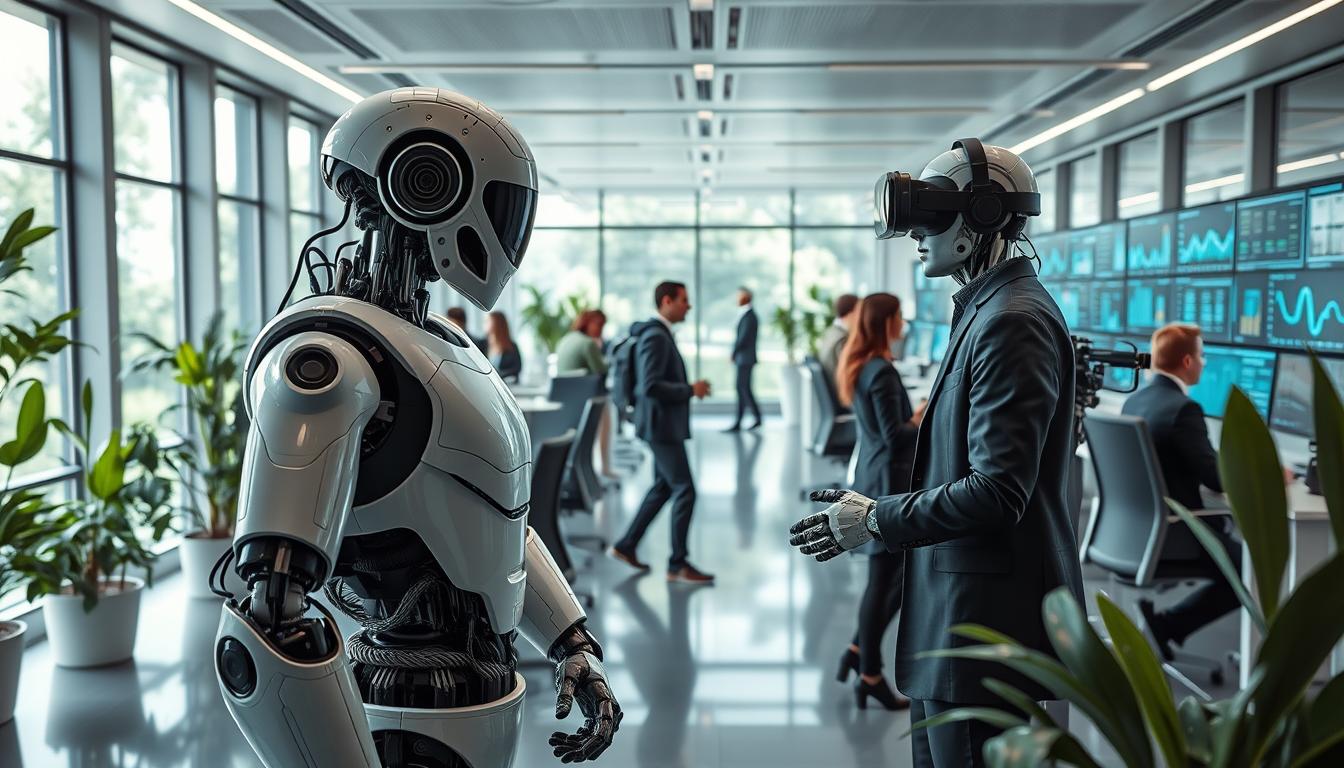
Artificial intelligence is changing the work world fast. The modern workplace is changing a lot, thanks to AI. It’s not just about replacing jobs; it’s about making us better and opening new doors1.
In banking, AI has made workers much more productive. Since 2009, bank employees have added $98,000 to their work value, showing AI’s big impact2. This change is happening in many fields as AI becomes a bigger part of our work.
AI is making work better by making tasks easier and helping us do more. For example, 1 million developers use Github copilot to write code, changing how software is made1. This mix of human ideas and AI power is leading to new ways to innovate and work better.
There are worries about jobs being lost to AI, with some saying it could take 300 million jobs13. But, AI is also making new jobs and changing old ones. By 2025, while 85 million jobs might go, 97 million new ones will come, showing AI’s positive effect on jobs3.
As we move forward with AI, we need to learn and adapt. Companies are starting programs to teach workers about AI, so they can work well with AI tools3. This is important for using AI to its fullest and for keeping jobs and skills relevant.
Key Takeaways
- AI is boosting productivity across industries, especially in banking and finance
- Developer tools like Github copilot are transforming code creation
- AI is expected to create more jobs than it displaces by 2025
- Upskilling and continuous learning are crucial for workforce adaptation
- Ethical considerations and data privacy are important in AI implementation
- AI is enhancing decision-making processes in various sectors
- The future workplace will focus on human-AI collaboration
Understanding AI and Its Impact on Employment
Artificial Intelligence (AI) is changing the job market in big ways. It brings both new chances and challenges. This tech, powered by machine learning and natural language processing, is changing industries and jobs.
What is AI?
AI means computer systems that can do things that humans usually do. They use AI algorithms to learn from data and make smart choices. Natural language processing lets machines understand and create text like humans. Machine learning helps them get better over time without needing to be programmed.
The Evolution of AI Technology
AI has grown from simple systems to complex neural networks. This growth has led to big steps forward in areas like healthcare, finance, and manufacturing. The job market is seeing big changes, with AI expected to create 20-50 million new jobs worldwide by 20304.
While some jobs might disappear, AI is also opening up new chances. By 2025, AI could replace 75 million jobs but also create 133 million new ones. This means a net gain of 58 million jobs globally4. In China, jobs in AI, big data, and manufacturing grew by nearly 30% from 2019 to 20225.
The manufacturing sector might see a lot of job loss due to AI. But healthcare and education are expected to grow a lot. It’s interesting that in China, industrial robots have actually led to more jobs5. This shows that workers need to learn new skills to keep up in an AI world.
Integrating AI in Daily Work Tasks
AI changes how we do our daily tasks, making work better and easier. It uses deep learning and cognitive computing to improve our routine and teamwork.
Automating Routine Processes
AI helps with boring tasks, giving us more time for important work. Virtual assistants manage our schedules and tasks really well, making us more productive6. They sort tasks by how urgent and important they are, helping us focus7.
AI also makes email better. It sorts and prioritizes emails, helping us answer faster by 45%6. This lets us spend more time on important tasks, not just emails.
Enhancing Collaboration and Communication
AI tools help teams work better together, even when they’re far apart. They look at who’s busy, suggest how to split tasks, and plan schedules based on how we work best7. This makes time management and teamwork better.
In managing projects, AI spots problems, assigns tasks, and looks at trends to keep projects on schedule7. Chatbots also make talking to customers 70% faster, making them happier68.
| AI Application | Benefit | Impact |
|---|---|---|
| Virtual Assistants | Calendar Management | 80% Efficiency Rate |
| Email Applications | Response Rate Increase | 45% Improvement |
| Chatbots | Response Time Reduction | 70% Faster |
As AI gets better, it will make our work even more efficient and collaborative. This will lead to a more productive workplace.
The Role of AI in Data Analysis
AI is changing how businesses analyze data and make decisions. With 90% of the world’s data created in the last two years9, the need for better tools and experts is clear.
Leveraging Big Data for Insights
AI helps organizations deal with huge amounts of data fast and right. As data grows by 150% in 20259, AI’s role is more important than ever. Neural networks and machine learning find patterns and insights humans might miss.
AI tools make data cleaning and processing much faster. What took 8 hours now takes less than 1 hour9. This speedup is why 54% of businesses save money with AI9.
Predictive Analytics in Decision Making
Predictive analytics, a key AI tool, uses past data to predict future trends10. It helps businesses make smart decisions, knowing what’s coming and what customers want.
Tools like BigQuery ML work with Vertex AI for powerful predictive analytics11. They make predictions in real-time, helping find new customers, suggest personalized products, and forecast demand11.
| AI Data Analysis Feature | Benefit |
|---|---|
| Automated data cleaning | Faster processing, reduced errors |
| Real-time insights | Quicker decision-making |
| Predictive analytics | Proactive business strategies |
| Natural language processing | Improved data accessibility |
As AI grows, data analysts need to keep learning. They must know AI and machine learning, be good at programming, and have soft skills like critical thinking and communication10. This mix of human and AI skills leads to better decision-making.
AI-Powered Tools Transforming Industries
Artificial intelligence is changing many sectors, including healthcare, finance, and manufacturing. These changes are making industries more efficient and opening up new possibilities.
Healthcare Innovations
AI is improving healthcare by making patient care better and operations more efficient. It could cut down on healthcare errors by 86%, saving over 250,000 lives each year12. In Sweden, AI helped find 20% more breast cancer cases in 80,000 women, showing its power in early detection12.

AI in Finance and Banking
The finance sector is using AI to improve customer service and make things run smoother. AI chatbots are now more than just info providers. They offer personalized support and solve problems quickly13. This change is making banking services more accessible and easier to use.
Enhancements in Manufacturing
AI is making big changes in manufacturing. The AI in manufacturing market is expected to grow to USD 695.16 billion by 2032, with a 37.7% CAGR12. One big company saw energy use drop by 6%, water use by 30%, and scrap by 9% thanks to AI, showing its role in sustainability and efficiency12.
As AI keeps getting better, it will be used in more areas, leading to more innovation and economic growth. The global AI market is set to hit $184 billion in 2024, growing at 28.46% annually until 2030. This shows AI’s growing role in all sectors13.
Improving Employee Experience with AI
AI is changing the workplace, making it better for employees. It helps with training and making work experiences unique. This way, employees learn, grow, and contribute more effectively.
Personalized Learning and Development
AI makes learning fit each person’s needs. It looks at what employees are good at and what they need to work on. Then, it suggests training that’s just right for them.
AI also helps leaders improve. It gives feedback on how they communicate and work with their teams. This makes leaders better at leading their teams. About 60% of business owners think AI will make work more productive. And 42% believe it will make jobs easier14.
AI in Recruitment and Onboarding
AI is making hiring and welcoming new employees better. It helps find the right candidates faster and makes onboarding smoother. 74% of those who hire people think AI can make tasks easier. And 67% believe it can find candidates quicker14.
Using AI for onboarding helps new employees learn faster. It lets them get training that fits their needs. This helps them do their job well from the start15.
| AI Application | Percentage of Organizations |
|---|---|
| AI-powered chatbots for instant messaging | 73% |
| AI for optimizing emails | 61% |
| AI for personalized services | 55% |
AI’s role in improving work for employees will keep growing. By using AI for training and making work experiences unique, companies can make work better for everyone.
Addressing Job Displacement Concerns
The rise of AI in the workplace has raised concerns about job loss in many industries. As AI gets better, it’s changing the job market. This brings both challenges and chances for workers around the world.
Jobs Most Affected by AI
AI automation could affect up to 800 million jobs by 2030. This includes jobs in manufacturing, finance, healthcare, and law. In factories, AI machines are taking over human jobs. In customer service, chatbots and virtual assistants are replacing humans16.
Retail and food services are seeing less need for workers because of self-checkout systems and automated kitchens. Finance and research are moving towards AI for big data analysis16. AI is also automating routine tasks, putting clerical and support staff at risk16.
Upskilling the Workforce
To tackle job displacement, upskilling is key. The U.S. Department of Labor has set guidelines for worker empowerment and ethical AI use17. These rules aim to benefit both employees and employers by involving workers in AI development17.
Future-proofing careers means always learning and adapting. Governments and companies should support lifelong learning. This helps workers keep up with changing job markets16. Working together, we can find solutions like retraining programs and new job opportunities16.
AI brings challenges but also chances to make work better. It automates repetitive tasks and creates demand for new skills17. By encouraging innovation and entrepreneurship, AI can create new jobs and industries, balancing out losses16.
The Ethical Implications of AI in the Workplace
AI is becoming more common in workplaces, raising ethical concerns. Companies are spending a lot on AI, with plans to spend $50 billion this year. By 2024, this number is expected to reach $110 billion annually18.
This fast growth brings challenges like AI ethics, algorithmic bias, and data privacy issues.
Ensuring Fairness in Algorithms
AI systems can carry biases from their training data. This can lead to discrimination in areas like employment and lending18. Companies need to focus on making algorithms fair and unbiased.
Having diverse teams to oversee AI is key to reducing bias. It’s suggested that boards monitor AI use to ensure fairness19. This helps keep ethical standards high and builds trust with employees.
Privacy and Data Security Challenges
Data privacy is a big worry in AI-driven workplaces. About 80% of businesses worldwide face security threats from cybercrimes19. Also, 85% of cybersecurity leaders say recent attacks were caused by AI use20.
Monitoring employees raises privacy concerns. In 2019, 50% of big companies used new ways to watch their workers19. Even though 61% of employees are okay with being watched, being open is key to keeping trust19.
To tackle these issues, companies must focus on ethical AI use. They should aim for fair algorithms and strong data privacy. This way, they can use AI’s benefits while keeping their workplaces ethical.
AI and Remote Work Dynamics
The way we work has changed a lot, with more people working from home. AI is changing how we work together and stay productive online. It’s making teams that are spread out work better together.
Tools Facilitating Remote Collaboration
AI is making remote work tools better. These tools help people work together, no matter where they are in the world21. Now, tools like Asana and Trello use AI to help manage tasks and track progress21.

AI is also helping with the boring stuff, like paperwork. This lets remote workers focus on harder tasks21. These AI tools get smarter over time, making better choices and helping in new ways21.
Maintaining Productivity with AI
AI is key to keeping remote work productive. It automates tasks, making work more efficient21. It also helps with data, giving teams the info they need to make smart choices21.
AI is also making creative work better in remote settings21. With more people working from home, AI tools are becoming a must-have22.
“AI is not just a tool for efficiency; it’s reshaping the very nature of remote work, enabling new levels of collaboration and creativity.”
Looking ahead, AI will play an even bigger role in remote work. By 2025, millions of new jobs will come from AI and automation22. This shows how important AI is for the future of remote work.
The Future of Leadership in an AI-Driven World
The world of leadership is changing fast with AI. Leaders need special skills to handle this new world well.
Evolving Leadership Styles
Leadership is evolving with AI. Now, leaders must use data and intuition together. They also need to be flexible with work models23.
Good AI leaders know tech, adapt quickly, and think ethically. They use AI to improve their skills in making decisions and building relationships24.
AI-Assisted Decision-Making
AI tools are changing how leaders decide. They give real-time data and predictions for better choices23. Leaders who use AI first get ahead25.
Using data is key with AI. AI helps humans by analyzing trends. This leads to better decisions and work efficiency23.
| Leadership Skill | Traditional Approach | AI-Enhanced Approach |
|---|---|---|
| Decision Making | Intuition-based | Data-driven with AI insights |
| Problem Solving | Linear thinking | Augmented intelligence |
| Team Management | Manual oversight | AI-assisted performance tracking |
As AI grows, leaders must keep learning. Investing in AI training helps employees use AI well23. By adapting, leaders can lead their teams to success in an AI world.
The Role of AI in Diversity and Inclusion
AI is changing how we tackle diversity and inclusion in the workplace. It gives us tools to fight bias and make spaces more welcoming. But, we must use it wisely to avoid making things worse.
Minimizing Bias through AI
AI helps reduce biases in decision-making. But, facial recognition systems can be unfair, especially to women and minorities. This is because they’re trained on biased data26.
AI also makes hiring decisions that can be unfair. It shows biases against certain groups26. This shows we need to develop AI with fairness in mind, using diverse teams26.
AI Tools for Enhancing Workplace Diversity
New AI tools aim to improve workplace diversity. AI helps find and fix biases in hiring, making it fairer26. These tools give insights into hiring patterns and track progress in diversity26.
AI keeps workplaces inclusive by checking on diversity efforts. It analyzes feedback and demographics to ensure everyone feels welcome26. It also teaches about diversity and inclusion through chatbots and educational tools26.
| Demographic | Representation |
|---|---|
| Women software engineers in US | 2 in 10 |
| Black or Latinx developers in US | Less than 1 in 10 |
| Men in senior business leadership | 7 out of 10 |
| White senior business leaders | 6 out of 10 |
AI brings both challenges and solutions for fairness and inclusion. As we explore AI, we must balance innovation with ethics. This is key to creating diverse and welcoming workplaces.
Preparing for an AI-Enhanced Future
We are entering a new era of work, and getting ready for AI is key. Companies must build a workforce that can quickly adapt to new tech. This means creating a culture of ongoing learning and embracing AI strategies.
Continuous Learning and Adaptation
Employees need new skills to succeed in AI-driven workplaces. Companies are investing in training in data science and machine learning27. This is crucial for staying agile and successful in the long run.
Local, open-source language models are becoming affordable for businesses to use AI28.
Embracing a Change-Friendly Culture
It’s important to have a culture that welcomes new tech. Companies are aligning their AI plans with their business goals27. This helps them improve customer service, increase sales, and make operations smoother.
Financial institutions are using AI for risk management and fraud detection27.
As we look ahead, businesses must weigh AI’s benefits against ethical concerns. Those ready for an AI future are focusing on innovation, improving skills, and ethical AI use27. By doing this, companies can excel in the changing work world.
Source Links
- https://www.forbes.com/sites/marenbannon/2023/06/22/how-ai-is-changing-the-future-of-work/ – How AI Is Changing The Future Of Work
- https://www.skedda.com/blog/ai-in-hybrid-workplaces – How AI Technology Is Revolutionizing The Modern Workplace
- https://www.forbes.com/councils/forbestechcouncil/2024/07/12/ai-and-the-future-of-work/ – Council Post: AI And The Future Of Work
- https://www.innopharmaeducation.com/our-blog/the-impact-of-ai-on-job-roles-workforce-and-employment-what-you-need-to-know – Innopharma Education Blog
- https://www.nature.com/articles/s41599-024-02647-9 – The impact of artificial intelligence on employment: the role of virtual agglomeration – Humanities and Social Sciences Communications
- https://www.morgan.edu/ceamls/news/enhancing-everyday-life-how-ai-is-revolutionizing-your-daily-experience – Enhancing Everyday Life: How AI is Revolutionizing Your Daily Experience
- https://clickup.com/blog/how-to-use-ai-for-daily-life-tasks/ – How to Use AI for Daily Life Tasks | ClickUp
- https://www.linkedin.com/pulse/enhancing-your-workday-10-strategies-integrate-ai-daily-lebedeff-hwbzc – Enhancing Your Workday: 10 Strategies to Integrate AI into Your Daily Routine
- https://www.luzmo.com/blog/ai-data-analysis – Using AI for Data Analysis: The Ultimate Guide (2025) | Luzmo
- https://www.iiba.org/business-analysis-blogs/how-ai-is-rewriting-the-rules-of-data-analysis/ – How AI Is Rewriting the Rules of Data Analysis | Analyst Catalyst Blog
- https://cloud.google.com/use-cases/ai-data-analytics – AI data analytics
- https://www.smartsocs.com/ai-transforming-industries-innovation-and-growth – AI Transforming Industries: Innovation and Growth
- https://www.autonomous.ai/ourblog/best-ai-tools – Best AI Tools Transform Businesses Across Industries
- https://www.deloitte.com/uk/en/services/consulting/blogs/2024/ai-powered-employee-experience.html – AI-Powered Employee Experience: How Organisations Can Unlock Higher Engagement and Productivity
- https://www.zendesk.com/blog/ai-for-employee-experience/ – 11 ways to use AI for a better employee experience
- https://labs.sogeti.com/the-ethical-implications-of-ai-and-job-displacement/ – The Ethical Implications of AI and Job Displacement
- https://www.dol.gov/general/ai-principles – Artificial Intelligence And Worker Well-being: Principles And Best Practices For Developers And Employers
- https://news.harvard.edu/gazette/story/2020/10/ethical-concerns-mount-as-ai-takes-bigger-decision-making-role/ – Ethical concerns mount as AI takes bigger decision-making role
- https://360learning.com/blog/ai-ethics/ – AI Ethics Concerns: Addressing Employee Worries
- https://online.hbs.edu/blog/post/ethical-considerations-of-ai – 5 Ethical Considerations of AI in Business
- https://www.starleaf.com/blog/the-future-of-remote-work-how-ai-and-automation-are-shaping-virtual-collaboration/ – How AI is Revolutionizing Remote Collaboration in 2024
- https://www.edvisors.com/blog/ai-and-remote-work/ – AI and the Future of Remote Work | Edvisors
- https://www.officespacesoftware.com/blog/work-leadership-ai/ – The Future of Leadership in an AI World | OfficeSpace
- https://www.linkedin.com/pulse/future-leadership-ai-driven-world-farshad-asl-nbdsc – The Future of Leadership in an AI-Driven World
- https://executive.berkeley.edu/thought-leadership/blog/future-work-leadership-age-ai – The Future of Work & Leadership in The Age of AI
- https://diversio.com/the-role-of-ai-in-diversity-equity-and-inclusion/ – DEI & AI: The Role of AI in the future of Diversity, Equity, and Inclusion
- https://www.linkedin.com/pulse/preparing-ai-powered-future-adrianne-phillips-yqomc – Preparing for an AI-Powered Future
- https://www.forbes.com/councils/forbestechcouncil/2023/11/28/preparing-for-the-future-of-ai-computing/ – Council Post: Preparing For The Future Of AI Computing