
A route suggestion on your phone or a spam message missing your inbox may be AI at work. These small moments show how artificial intelligence now fits into everyday life, often without fanfare.
In a 2025 nationwide survey, 57% of U.S. respondents said they used AI for personal purposes. Forty percent said their use had increased over the previous year. A 2025 YouGov survey found that 56% of American adults used AI tools, and 28% used them at least once a week.
You might use these tools to find information, plan a trip, or get help with questions. This guide explains how they learn, where they show up, what they can do, and where they fall short. You will also find simple ways to try them and judge their answers with care.
Key Takeaways
- AI supports specific tasks, from route planning to sorting email.
- Machine learning helps computer systems find patterns in data.
- Generative AI can create text, images, audio, video, and code.
- AI can save time, but its answers can still be wrong.
- Start with one low-risk task and check the result yourself.
- Keep people responsible for decisions that matter.
Treat an AI answer as a useful starting point, not automatic proof that it is correct.
What Is Artificial Intelligence?
Artificial intelligence is the field of building computer systems that can perform tasks commonly associated with human intelligence. These systems use data and algorithms, or sets of instructions, to complete defined tasks.
AI is a broad field, not one all-purpose machine. A system may be built to recognize speech, sort images, find patterns, or support a decision. It does not need to look like a robot or act like a person.
A system can be useful at a specific task without having human judgment, awareness, or understanding.
Some AI systems learn from examples. Others apply rules or methods designed for a particular job. The field draws on computer science, engineering, and mathematics to build and study these systems.
Common abilities include learning, reasoning, problem-solving, perception, and language processing. Here, reasoning means using available information to reach a result, not human thought or awareness.
In a 2025 Elon University survey, 52% of U.S. adults said they used large language models such as ChatGPT, Gemini, Claude, and Copilot. A 2025 nationwide survey found 57% used AI for personal purposes, while 40% said their use had grown over the previous year.
A 2025 YouGov survey found that 56% of American adults used AI tools, and 28% used them at least weekly. These figures describe different surveys and measures, but all show that many adults have tried the technology.
The label covers many kinds of systems, from software that detects patterns to tools that work with language. A chatbot is only one familiar example.
How Does Machine Learning Learn From Data?
A computer can learn to sort photos of cats by studying labeled examples instead of following a hand-written rule for every possible cat. Machine learning is a way for a computer system to find patterns in data and improve how it performs a task without a programmer writing a rule for every situation.
Machine learning is how computers use data to improve task performance without an explicit rule for every case. A model is the part of a system that uses patterns learned from data to make a prediction or choice.
In a simple cycle, a system receives examples, finds patterns, and makes a prediction. Feedback can then show whether the result was useful or mistaken.
Supervised learning uses labeled examples. For example, a set of photos marked “cat” or “not a cat” can help a system learn to sort new images.
Unsupervised learning looks for patterns in data without labels. A store might group similar purchases to spot common buying habits, without first naming each group.
Reinforcement learning uses rewards and penalties to guide actions. A game-playing system might receive a reward for a successful move and learn which choices help it win.
Transfer learning means applying what a model learned on one task to a related task. A model trained to recognize objects may need less new training to sort similar objects.
Training examples shape what a model can learn. If those examples leave out important cases, the system may struggle when it meets them later.
Feedback can guide improvements, but it does not turn every prediction into a fact. People still need to judge whether a result fits the task.
Better training examples can improve a model, but they cannot guarantee that every new answer will be right.
How Are AI, Machine Learning, and Deep Learning Different?
AI is the broad field, machine learning is one approach within it, and deep learning is a machine learning approach built around multilayer neural networks. Think of them as nested terms, not competing names.
Machine learning sits inside AI, while deep learning sits inside machine learning. Generative AI describes systems that create content, so it does not name every kind of AI.
AI Covers Many Kinds of Systems
AI includes systems that use different methods to complete different tasks. Some follow rules; others learn patterns from data. The name describes the wider field.
| Term | Relationship to the broader field | What it is used to do |
|---|---|---|
| Artificial intelligence | The broad field | Build systems for tasks such as speech recognition |
| Machine learning | One approach within AI | Find patterns in data and make predictions |
| Deep learning | A type of machine learning | Use multilayer neural networks to process patterns |
| Generative AI | A type of content-making system | Create text, images, audio, or other material |
Machine Learning and Deep Learning Use Data in Different Ways
Machine learning includes methods that do not use deep learning. Deep learning uses neural networks with multiple layers, which can handle complex patterns in data.
For example, a system that predicts a number from a few clear features may use a simpler machine learning method. A system that processes complex images may use deep learning.
The terms help you describe the approach, not just the task. A generative system might use deep learning, but generation is only one use of AI.
Use the terms as a family tree, not as interchangeable names for the same technology.
What Do Neural Networks and Language Processing Do?
A neural network passes information through connected layers so a system can detect patterns that are difficult to capture with a short list of rules. The layers work together to process data.
A neural network is made of connected processing units arranged in layers. This is a simplified picture: each layer changes information before passing it along.
During training, a network adjusts how it handles examples. The finished model can then use learned patterns to process new information, such as a line of text or a picture.
Natural language processing lets computers analyze, understand, and generate human language. It can work with written text or spoken words, though its results do not show human understanding.
A translation tool uses language processing to turn text from one language into another. Speech recognition turns spoken words into text, while other systems can use text to produce speech.
Computer vision analyzes images and video. A vision system can identify shapes or objects in a picture, or track changes across video frames.
Transformers are a neural network architecture that became important for processing sequences, such as words in a sentence. Their development helped accelerate AI after 2017.
Increased computing power and progress in neural networks also helped support that change. These advances made it easier to train systems on large amounts of data.
The same underlying pattern-learning idea can support very different tasks, from recognizing speech to sorting images.
What Can Generative AI Create, and How?
A generative AI tool can turn a written prompt into a draft, an image, a short audio clip, or a piece of code. A prompt is an instruction or request, and the wording helps set the task.
Generative AI can make text, images, video, audio, and software code. Different models work with different kinds of input and output.
Generative AI Makes Several Kinds of Content
Large language models are trained to work mainly with language. They can produce text from a prompt, while image models create or process pictures.
Other generative systems can work with sound, video, or code. Some tools combine formats, such as a written request that produces an image with a text description.
Generated material follows patterns learned during training. It may be new, but that does not mean it is unique, accurate, or safe to use without review.
Training and Tuning Shape a Generative Model
Development can begin with training a foundation model on a broad set of data. A foundation model is designed to support many later tasks.
Developers can then tune the model for a particular application. Tuning adjusts the model’s behavior for a narrower use, such as answering questions about a product.
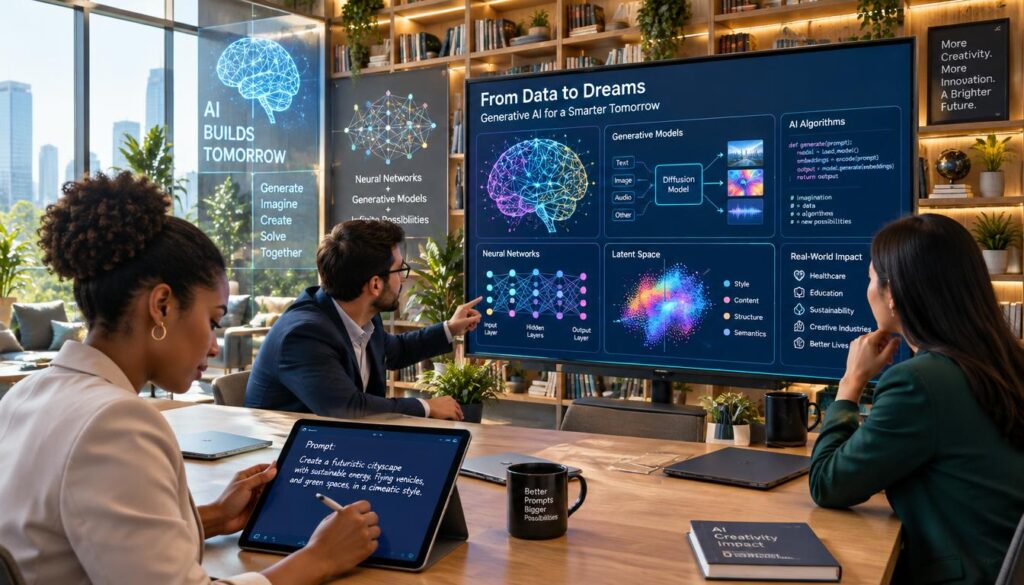
After tuning, a user enters a prompt and the model generates an output. Developers may test results and use feedback to make further improvements.
A polished answer can still include a made-up detail or miss the request. The look and feel of the result do not prove that it is correct.
Check the output against your goal before treating a polished result as a reliable one.
Where Do You Encounter AI in Everyday Life?
A navigation app that adjusts a route or a streaming service that recommends a show is using pattern-based predictions in an ordinary task. These features often sit inside familiar apps.
Many everyday AI features predict, sort, or respond to information you provide. They perform a defined task rather than understanding your needs like a person.
- Google Maps can suggest routes using travel information and your destination.
- Streaming services can recommend shows based on patterns in viewing activity.
- Email filters can sort messages that resemble spam.
- Siri and Alexa can respond to spoken requests using voice technology.
- Chatbots can answer learning questions or summarize a document you provide.
Chatbots can also help you explore a subject or organize an idea. Their answers still come from patterns in data, not personal knowledge.
In a 2025 Elon University survey, 51% of large language model users said personal, informal learning was their main use. Another 24% named work activities as their main use.
Two-thirds of users said they used these models like search engines. About half said they used them to brainstorm ideas or summarize documents.
Half of users said their use had improved their ability to learn new skills and concepts a lot or somewhat. That reports what users felt, not a result that every person will get.
For a quick fact or summary, compare the answer with a trusted source before relying on it.
How Do People Use AI at Work?
At work, AI is most useful when it takes a first pass at repetitive tasks or helps sort through a large volume of information. That can leave more time for review and judgment.
People remain responsible for sensitive decisions and for checking AI-assisted work. A fast draft or pattern alert is a starting point, not a final call.
AI Can Assist With Repetitive and Information-Heavy Tasks
Teams may use AI to summarize long documents, draft and edit content, or help answer customer questions. Software developers can also use code assistance tools.
Some systems flag possible fraud by finding unusual patterns in transactions. Recruitment teams may use tools to help with administrative steps, while factories may predict when equipment needs maintenance.
These uses differ from trying a chat tool for personal interest. At work, the system may handle company information or affect customers, workers, and business choices.
Small Businesses Use Generative AI in More Ways
About one in five respondents in a 2025 Brookings survey said they used AI in their professional lives. In a separate measure, 58% of surveyed U.S. small businesses used generative AI in 2025, up from 40% in 2024.
In a 2025 Elon University survey, 54% of large language model users said their use had improved productivity a lot or somewhat. That is a report of user experience, not proof that AI caused every improvement.
A good workplace process gives staff time to review results and correct errors. The right checks depend on what the tool does and who could be affected.
Keep a human review step for any AI-assisted decision that affects a customer, worker, or important business outcome.
Which AI Tools Are Most Widely Used?
ChatGPT led the 2025 U.S. survey of large language model users, followed by Google Gemini and Microsoft Copilot. The survey asked about tools tried.
ChatGPT was used by 72% of surveyed users, compared with 50% for Gemini and 39% for Copilot. People could have tried more than one tool, so the percentages overlap.
| Tool | Share of LLM users who had tried it |
|---|---|
| ChatGPT | 72% |
| Google Gemini | 50% |
| Microsoft Copilot | 39% |
| xAI Grok | 12% |
| Anthropic Claude | 9% |
Global use measures tell a different story from a U.S. survey. In January 2026, ChatGPT had 2.7 times Gemini’s monthly web traffic and 2.5 times its monthly active mobile users in global rankings.
ChatGPT had 900 million weekly active users worldwide in January 2026, after adding 500 million over the previous year. About 20% of its weekly web users also used Gemini in a given week.
Grok is an AI product associated with X, and it is also available as an iOS and Android app. Its features include image generation, web search, Think reasoning mode, and Grok Build.
Grok is integrated with X, but that does not establish which tools Elon Musk personally uses. Product features and personal use are separate questions.
These figures do not make one tool best for every job. Different tools can suit different needs, such as writing, research, or work with files.
Compare tools by the task you need to complete, not by popularity alone.
Which Free AI Tools Can Beginners Try?
A beginner can start with Google Gemini for everyday questions or NotebookLM for exploring a set of reading materials. Both offer a low-friction starting point for different tasks.
Google AI Studio is free to use in all available regions, while its Gemini API free tier has lower rate limits. Gemini is free for users age 18 and older with a personal Google Account, or a Workspace account whose administrator enabled access.
NotebookLM helps you work with supplied reading materials. Its free plan allows 100 notebooks, 50 sources per notebook, and up to 500,000 words per source.
| Tool or access type | Free access or usage limit | Useful starter task |
|---|---|---|
| NotebookLM | 100 notebooks, 50 sources each | Explore a set of reading materials |
| Gemini CLI, Google account | Up to 1,000 model requests per day | Try model requests from a command line |
| Gemini CLI, unpaid API key | Up to 250 requests daily, 10 per minute | Test a small command-line workflow |
| Speech-to-Text | 60 minutes monthly | Turn short audio into text |
| Text-to-Speech | 4 million Standard or 1 million WaveNet characters | Make spoken audio from text |
Google AI Studio lets you try Gemini models, and developers can use Gemini CLI from a command line. Google Cloud also offers free speech and translation use for developers.
Google Cloud’s free Translation usage includes 500,000 characters per month. The speech and translation services have separate limits, so match the allowance to your test.
- Task: Choose one clear job, such as summarizing notes.
- Account: Check whether you need a Google account or API key.
- Usage: Note the request, character, or time limit.
- Data: Read how the service handles the material you submit.
Free plans can change, and a request cap may matter once you use a tool often. Select a tool for its task and limits, not just its name.
Confirm account eligibility and the relevant usage limit before building a regular workflow around a free tier.
What Are the Main Benefits of AI?
AI can save time when it handles a repetitive first pass and leaves people to review the result or make the final decision. The time saved depends on the task.
AI can process information quickly, automate routine digital work, find patterns, and support predictions. Each benefit is useful only when the task fits the tool.
A system can summarize a long document so you can scan its main points sooner. You still need to read closely when small details matter.
Automation can handle repeated digital steps, such as sorting records into groups. Pattern analysis can flag an unusual transaction for a person to examine.
In a 2025 Elon University survey, 54% of large language model users said their use improved productivity a lot or somewhat. Half said it improved their ability to learn new skills and concepts a lot or somewhat.
These are user reports, not results that apply to everyone. A poor fit, weak input, or missing review can erase the expected gain.
AI can support a choice by organizing information or highlighting a pattern. A person still needs to decide what the result means in context.
Measure the benefit by whether the task becomes more accurate or useful, not just faster.
What Are the Risks and Limits of AI?
An AI answer can sound certain while still getting a name, date, explanation, or recommendation wrong. A confident tone is not evidence.
In a 2025 survey, 23% of large language model users said they had made a significant mistake or bad decision by relying on AI-generated information.
AI Can Produce Wrong or Biased Results
Some false AI outputs are called hallucinations. The term describes material that sounds plausible but is not true.
Training data can also leave out groups or reflect unfair patterns. A system trained on unbalanced examples may produce results that treat people unfairly.
Conditions can change after a system is built. When real-world patterns shift, a model may no longer fit the task as well.
Data Privacy and Security Need Attention
A prompt may include personal details, work files, or confidential information. What happens to that material depends on the service and its settings.
AI systems can also face data breaches and cyberattacks. Security problems can expose information or disrupt how a tool works.
- Wrong output: A plausible answer may include false details.
- Bias: Unbalanced examples can lead to unfair results.
- Changing conditions: Old patterns may no longer match current events.
- Privacy exposure: A prompt may contain personal or confidential data.
- Security threats: Breaches and attacks can affect systems and information.
Use care when an answer affects money, health, work, or another important choice. The reported mistakes show why reliance can have real consequences.
Do not let a confident tone substitute for checking a high-stakes claim.
How Can You Use AI More Safely?
Before relying on an AI answer, check the claim against a source you would trust without the tool. Important details deserve a closer look.
Keep people responsible for choices that could affect someone’s health, rights, money, or safety. A short check can catch errors before they spread.
- Verify important claims with a reliable source.
- Check names, dates, and calculations.
- Remove personal or confidential details before submitting a prompt.
- Review generated images, text, or code for bias and errors.
- Keep a human decision-maker involved in consequential choices.
These steps work for a short answer as well as a longer report. For a calculation, repeat the math; for a name, confirm the spelling.
Retrieval-augmented generation connects an AI response with relevant outside material. It can give the system useful context, but it does not guarantee an accurate answer.
Responsible AI practices also include fairness, explainability, accountability, robustness, security, and privacy. These ideas help people judge how a system should be built and used.
For medical, legal, or financial decisions, use AI to prepare questions and consult a qualified professional before acting.
What Careers and Degrees Are Connected to AI?
AI work ranges from building models to deciding how organizations should use them responsibly. Different roles need different strengths.
An artificial intelligence degree is one path, not the only path into AI work. Computer science, mathematics, statistics, data science, and engineering can all build useful skills.
AI Careers Solve Different Kinds of Problems
AI product managers guide the design and release of AI products. Research scientists study new methods, while large language model specialists work with language-based systems.
AI architects plan how systems fit together. AI ethicists or compliance officers focus on responsible use and rules.
| Role | 2026 U.S. salary range | Core work |
|---|---|---|
| AI product manager | $140,000-$195,000 | Guide AI product planning and delivery |
| AI research scientist | $105,000-$170,000 | Study and develop AI methods |
| LLM specialist | $125,000-$170,000 | Work with large language models |
| AI architect | $90,000-$180,000 | Plan AI systems and how they fit |
| AI ethicist or compliance officer | $60,000-$150,000 | Review responsible use and compliance |
Role duties and pay vary by employer and experience. The listed U.S. salary ranges give a sense of the range reported for these roles in 2026.
Degrees Build the Skills Behind Those Roles
Useful foundations include programming, statistics, data analysis, and responsible AI. Research roles often involve deeper study of models and machine learning.
A degree may combine several subjects, while hands-on projects show how you use them. A strong program makes time for both core ideas and practical work.
Compare programs by the skills and hands-on experience they provide, not by the degree title alone.
What Can Today’s AI Do, and What Can’t It Do?
Today’s AI is capable in specific tasks, but success at one task does not mean a system can do everything a person can do. Most systems are narrow AI, built for one task or a related set of tasks.
Focused skill does not make an AI system generally intelligent or self-aware. A language tool, image recognition system, or spam filter can perform its assigned task without broad human abilities.
Some AI tools can produce strong results in a narrow setting. That does not mean they can easily transfer those results to a very different job.
An AI agent is a system that can use available tools to pursue a specified goal. For example, an agent might search for information and then organize it into a report.
Agentic AI describes coordinated agents working on a larger task. The term does not mean the systems have human intent or awareness.
Artificial general intelligence, or AGI, is a theoretical idea for AI with broad abilities across many tasks. No known AI system approaches that breadth.
Judge a tool by its demonstrated ability on the task you actually need, not by claims about humanlike intelligence.
Keep the goal clear when you assess an AI system. A tool that handles one task well may still need help with a different one.
How Can a Beginner Get Started With AI?
Start with one small task, such as turning your own notes into a short summary, rather than trying to learn every AI term at once. A manageable test teaches more than a long list of tools.
For many beginners, a straightforward conversational assistant is the easiest first step. The best choice still depends on the task you want to complete.
- Choose one practical task, such as organizing notes or drafting a simple outline.
- Try a tool with non-sensitive material that you can check.
- Compare its result with an answer or source you trust.
- Learn core ideas such as data, models, and machine learning.
- Choose a general-audience book or try hands-on coding.

ChatGPT had been used by 72% of large language model users in a 2025 U.S. survey. That makes it a familiar starting choice, but popularity does not show which tool fits your task.
One book option is Artificial Intelligence: A Guide for Thinking Humans by Melanie Mitchell. It offers a general-audience introduction to the field.
If you want to learn technical skills, Python is widely used for machine learning and data work. Start with basic programming, then try a small project using data you understand.
Keep a brief record of what the tool got right, what it missed, and what you had to correct.
Conclusion
AI is most useful when you know the task, understand the limits, and stay responsible for the final decision. It can help with a clear job, but it does not replace careful judgment.
Important information still needs checking, especially when a mistake could affect someone’s health, money, or work. A quick comparison with a trusted source can reveal what needs a closer look.
Choose one low-risk task this week, try an AI tool, and check its result before using it.