
AI is the broad goal of building systems that perform tasks associated with human intelligence, while machine learning is one way to build those systems by learning patterns from data. For a business choosing new technologies, the difference can shape what a tool can do and what information it needs. AI can handle complex tasks through different methods, not just learning from examples.
A model is the learned result of training an algorithm on data, used to make predictions or perform a task. An algorithm is a method or set of instructions a system follows. Some AI systems use models, while others follow rules written by people. Many combine both to reach a useful result.
Understanding the difference helps you judge what happens behind a product label. You can ask whether a system follows instructions, learns from data, or uses both. That matters when you assess its limits, costs, and role in daily work. Treating the terms as interchangeable can hide whether a system follows written rules or learns from examples.
Key Takeaways
- AI is the broad field of building systems for tasks linked to human intelligence.
- Machine learning is a data-driven way to build some AI systems.
- Deep learning is a specialized form of machine learning that uses neural networks.
- Some AI tools use human-written rules instead of learning patterns from data.
- A single application can combine rules, models, and other technologies.
What Is Artificial Intelligence?
An AI system can follow explicit rules, learn from examples, or combine both approaches to complete a task. AI covers tools that recognize information, make recommendations, or respond to language. Not every system learns from data, even when it performs work that seems intelligent.
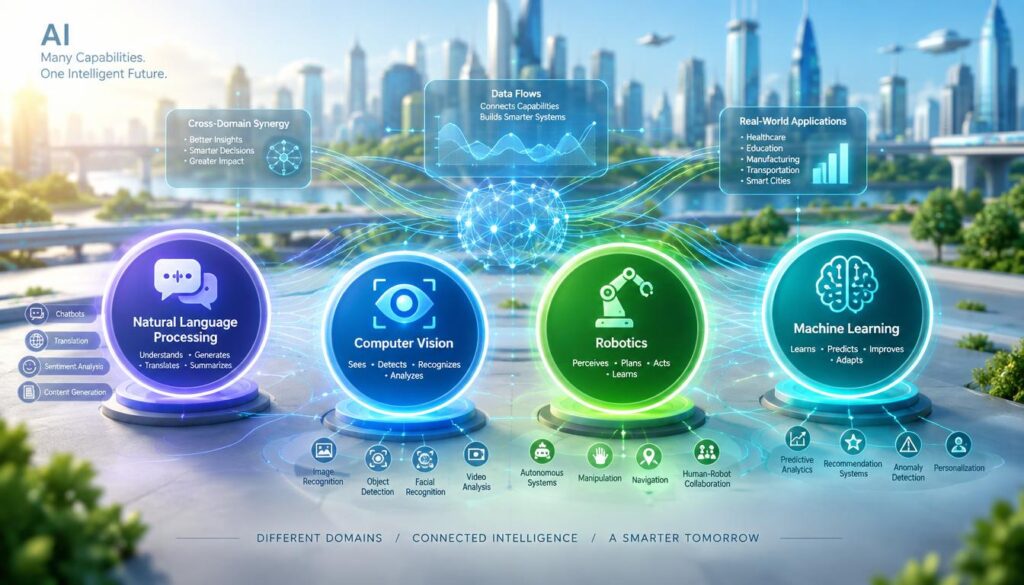
AI describes a field of methods, not one kind of software. Some methods use natural language processing, which helps computers work with human language. Others use computer vision to interpret images, or robotics to sense and act in the physical world.
Four approaches show how wide the field can be:
- Robotics lets machines sense their surroundings and carry out physical actions.
- Expert systems apply knowledge and rules written for a specific subject.
- Natural language processing helps systems handle spoken or written language.
- Rule-based systems follow instructions set by people for known situations.
Siri, Amazon Alexa, and IBM Watson are familiar examples of narrow AI. Each is designed for a limited set of tasks rather than every kind of thinking a person can do. A voice assistant may use language tools alongside rules and learned models.
An AI system does not need to learn from data to perform an AI task.
That distinction can help when you assess a product. A system that checks a fixed list of conditions may be easier to understand than one that learns patterns. For a task with stable, clearly stated rules, a rule-based system can be a practical AI approach without machine learning.
What Is Machine Learning?
A machine-learning system uses examples to find patterns that help it make a prediction or decision. It can sort messages, estimate demand, or flag an unusual payment. The quality of its results depends in part on the examples it receives.
Machine learning turns examples into a model that can handle new cases. People choose learning algorithms and prepare data for a task. The system then uses patterns in that data to produce an output.
How Models Learn From Data
A model is the learned result of training an algorithm on data, used to make predictions or perform a task. During training, the algorithm adjusts the model to fit patterns in examples. The finished model can then make a prediction for information it has not seen before.
New information can improve a model’s performance when people use it for further training. That does not mean every model keeps learning after deployment. Some remain fixed until their owners train and release an updated version.
Learning algorithms use different kinds of examples and feedback. Three common approaches are:
Three Common Machine-Learning Approaches
- Supervised learning uses labeled examples, such as photos marked “cat” or “dog.”
- Unsupervised learning looks for patterns in data without labels attached.
- Reinforcement learning uses feedback from actions, such as rewards or penalties.
These approaches suit different tasks. A labeled set can teach a model to sort known categories, while unlabeled data may reveal groups no one named in advance. Feedback from actions can help a system improve choices over repeated attempts.
Training data shapes what a model can recognize, so its limits matter. Check whether the training examples represent the cases the model will face, since missing or unrepresentative examples can limit its results.
Artificial Intelligence vs Machine Learning: How Do They Differ?
AI is the broader field, and machine learning is one way to build AI systems. Machine learning is a subset of AI because it uses data to learn patterns. Deep learning is a subset of machine learning, and LLMs are specialized deep-learning models focused on language.
Each term names a narrower part of the same hierarchy. The table compares their scope, method, and typical example.
| Approach | Scope | How it works | Example |
|---|---|---|---|
| AI overall | Broader field | Rules, learning, or both | Robot that follows set actions |
| Machine learning | Subset of AI | Pattern learning from data | Model predicting sales |
| Deep learning | Subset of machine learning | Layered neural networks | Image recognition model |
| LLMs | Language-focused subset of deep learning | Predicts text tokens | Chat assistant |
A nested AI, ML, and deep learning diagram shows the relationship more clearly than a Venn diagram. Each smaller category sits within the broader one, rather than overlapping as a separate field. AI also includes non-ML approaches such as robotics and expert systems.
That is why the search phrase “Artificial intelligence vs machine learning vs deep learning” describes nested terms, not competing technologies. An AI, ML, and deep learning diagram should show the same nesting. An AI, ML, and deep learning Venn diagram can mislead if it suggests deep learning sits outside machine learning.
Use the hierarchy to make product claims more precise. A service may use more than one approach, and its label alone does not explain every part. When someone says “AI,” ask which approach powers the particular task.
How Do AI and Machine Learning Work Together?
A voice assistant can be an AI application even when machine learning handles only one part of its response. The full application receives a request, gathers information, and chooses what to show or say. One model may supply a prediction inside that larger process.
AI can exist without machine learning through a rule-based system or expert system. When a task benefits from prediction, an ML model can add a data-driven step to the application.
A Google Nest commute-time response shows the difference between an application and one model task. The service can use live transit and traffic information, while a machine-learning model forecasts traffic conditions. A possible workflow looks like this:
- The AI application receives an objective, such as estimating a commute.
- It gathers relevant inputs, including live traffic and transit information.
- An ML model identifies patterns or makes a prediction when useful.
- The application uses that result to choose or present an action.
The model’s forecast is only one part of the response. The application still needs to connect that estimate to the user’s request and present a useful result. This kind of design can support operational efficiency when a business automates a step that depends on changing information.
Applications vary in how much work a model performs. A fixed rule may handle one decision, while a model may estimate what happens next. Identify the specific prediction or decision an ML model contributes before calling an entire application “machine learning.”
How Does Deep Learning Fit Into AI and ML?
The key difference is that deep learning can learn useful features from raw inputs, while classic machine learning often relies on people to choose them. A feature is a useful detail in data, such as an image’s edges or a customer’s purchase count. Feature choice can shape what a model learns.
Deep learning is a machine-learning approach built around neural networks. Its layered structure can help find features in complex inputs. People still guide the task, prepare data, and check results.
Traditional Machine Learning and Feature Selection
With classic machine learning, people often select useful features before training. For a model that sorts emails, they might choose word counts, sender details, or message length. This can work well when the data has a clear structure and experts know which details matter.
Some traditional models need human changes to handle new information or tasks outside their initial training. Their strengths can include simpler setup and clearer control over the input features. The best fit depends on the task and the data.
Deep Learning and Neural Networks
Neural networks process information through connected layers. Deep-learning networks can learn features from raw, unstructured data such as text and images. They can discover useful details with less manual feature selection, though human input still matters during design and review.
Neural networks with more than three layers are described as deep-learning networks. A 2012 breakthrough in artificial neural networks helped enable machines to use reinforcement learning and simulate aspects of human information processing.
| Approach | Who selects features | Suitable input | Typical strength |
|---|---|---|---|
| Traditional ML | People often choose them | Rows of customer or sales data | Works with clear, structured features |
| Deep learning | Network learns many features | Raw text or image pixels | Finds complex patterns in large inputs |
| Traditional ML | People adjust feature set | Measured values in a table | Can suit smaller, defined tasks |
| Deep learning | People guide, network learns | Large sets of images or text | Builds layered feature representations |
That added feature learning can make deep learning useful for complex inputs, but it can also call for more computing and data. For a small, well-structured dataset, manually selected features may be a simpler fit than a deep network.
What Are the Seven Types of AI?
The seven commonly described types come from two separate ways of classifying AI: capability and functionality. The categories describe what a system can do or how it handles information. They are not seven steps that every system follows.
As of 2026, narrow AI is the only capability type that exists. Artificial general intelligence and artificial superintelligence remain theoretical, as do two functionality types.
Three Capability Categories
The capability framework groups AI by the range of tasks it could perform. It includes:
- Narrow AI handles specialized tasks within a limited area.
- Artificial general intelligence (AGI) aims to perform many intellectual tasks at a human level.
- Artificial superintelligence (ASI) is hypothetical and would exceed human capabilities.
These labels describe different levels of proposed ability. AGI and ASI are not simply more advanced versions of every narrow AI product. They refer to capabilities far beyond one specialized task.
Four Functionality Categories
The functionality framework focuses on memory and social reasoning. Its four categories are:
- Reactive machines have no memory of past events.
- Limited-memory AI uses past and present data without keeping a long-term library of experiences.
- Theory-of-mind AI would understand beliefs and emotions, but remains theoretical.
- Self-aware AI would have awareness of itself, but also remains theoretical.
Limited memory differs from a lasting record of every past experience. A system can use recent or stored data for a task without building human-like memories. The two frameworks classify AI in different ways, so a category from one is not a step toward a category in the other.
Use these names carefully when comparing technologies. A system’s label may describe a goal or theory rather than a real ability. Treat a type label as a description of a proposed capability, not proof that the capability exists.
How Do Generative AI and LLMs Work?
Generative AI creates new content, while a large language model generates language by predicting what comes next in a sequence. Many ML tasks predict a value or sort information; generative tools produce new material. Language models are one kind of generative AI.
Generative AI can create text, images, code, audio, or video. DALL-E and Midjourney are image generators, while LLMs focus on language. These tools use different model designs for different content.
What Generative AI Can Create
A text tool may draft a summary, while an image generator creates a picture from a prompt. Other systems can create music, speech, video, or computer code. Their outputs depend on the task and the information in the prompt.
How an LLM Produces Language
LLM training can use billions or trillions of words from books, articles, websites, and code. The process includes several steps:
- Collect large text datasets from sources such as books, websites, and code.
- Break text into tokens, which can be words, subwords, or characters.
- Use self-supervised pretraining to infer targets from unlabeled text.
- Adjust weights through prediction, error measurement, backpropagation, and gradient descent.
- Fine-tune on a smaller labeled dataset for tasks such as summarization or classification.
A transformer uses self-attention to relate tokens across a sequence. Transformers introduced in 2017 made it easier for models to weigh how words relate across text. An LLM then repeatedly predicts the next word or token, using each new result as context.
Tokens are not always complete words. A long word may split into smaller parts, while a short word may form one token. Generated content can sound fluent without guaranteeing that every detail is accurate.
Where Are AI and Machine Learning Used?
A streaming recommendation is one everyday example of a model turning past behavior into a prediction. Netflix can use viewing-history data to suggest shows or movies a viewer may enjoy. May enjoy matters because a prediction is not a promise.
A recommendation estimates likely interest, rather than guaranteeing what someone will choose. Other applications use models to classify information, find objects, or interpret speech.
Recommendations and Predictions
Past choices can reveal patterns that help a system rank possible options. A streaming service may compare a viewer’s history with patterns in viewing data, then suggest a title. The suggestion is a starting point, not a sure measure of taste.
Prediction tasks also appear in business tools. A model can estimate a likely outcome from data, while an AI application uses that estimate to support a decision. The same kind of prediction can serve different goals in different settings.
Computer Vision and Language Tasks
Computer vision helps systems interpret images and video. Image recognition and classification assign labels, such as identifying a bird species. Object detection finds items and their locations, while object tracking follows them across frames. Facial recognition compares face patterns for identification.
Language tools handle different jobs, too. Speech recognition turns spoken words into text, while other natural language processing tools may summarize or classify written text. These tasks do not all rely on the same model.
| Application | Input | Model task | Output |
|---|---|---|---|
| Movie recommendations | Netflix viewing history | Estimate likely interest | Suggested movie title |
| Image classification | Photo of a golden retriever | Assign image label | “Dog” category |
| Object detection | Street-camera frame | Find objects and locations | Car bounding box |
| Speech recognition | Spoken appointment request | Convert speech to text | Recognized sentence |
Different outputs call for different checks. A label may be correct even when an object’s location is off, and a suggested movie may not match a viewer’s mood. Check whether an application’s output is a suggestion, a classification, or a location estimate before judging what it can do.
Is ChatGPT AI or Machine Learning?
ChatGPT is an AI service that uses large language model technology, so it also involves machine learning. Its language abilities come from LLMs, a specialized form of deep learning and therefore a part of ML. ChatGPT itself is more than a model.
The public-facing service is an interface to underlying models. An interface lets you send prompts and receive responses, while a model generates outputs. The two terms describe different parts of the tool.

ChatGPT is classified as narrow AI because it is limited to text-based chat. That label describes its task range, not a lack of language skill. A capable chat tool still does not perform every kind of intellectual work.
Other public-facing LLM tools and model families include Claude, Copilot, Llama models, and Gemini. Their products do not all work in the same way. Each can differ in its model, interface, and available features.
When comparing AI tools, look at both layers. The model affects how the system produces answers, while the interface shapes how you use it. When comparing AI tools, check both the underlying model and the interface that gives you access to it.
Should You Learn AI or Machine Learning First?
Start with the broad AI concepts, then move into machine learning if you want to build and test data-driven models. You do not need prior ML knowledge to begin Google’s Machine Learning Crash Course. Helpful preparation can make the lessons easier, but it is not all a strict entry requirement.
Python experience is recommended, while calculus is optional. The course recommends basic math and useful linear algebra for parts of the material.
Background That Helps With Machine Learning
Useful math includes variables, linear equations, function graphs, histograms, and statistical means. Familiarity with tensors, tensor rank, and matrix multiplication can help with linear algebra. Derivatives, gradients, partial derivatives, and the chain rule help with advanced topics.
You can start without knowing every term. A learner with basic Python can work through examples and build skills as new ideas appear. Computer science experience may help, but the course does not require prior machine learning knowledge.
A Practical Starting Route
Use a simple path that matches your goal:
- Learn the difference between AI and machine learning.
- Refresh Python and the core math listed above.
- Try browser-based exercises in Colaboratory without local setup.
The exercises use NumPy, pandas, and Keras. They do not teach those tools’ APIs in depth, so familiarity can help you follow the code. You can still begin and learn more about a library when an exercise calls for it.
Begin with the math and coding you already know, then fill gaps as an exercise requires them.
That approach keeps preparation tied to a real task instead of an endless list of prerequisites. Choose one exercise and note which skill slows you down. Then practice that skill before continuing.
Conclusion
The useful distinction is simple: AI describes the broader goal, and machine learning is one way to pursue it. That difference helps you judge what a technology does, what information it uses, and where human-written rules still guide the process.
For a business tool or a personal app, look past the label. Identify the task, the data or rules behind it, and whether the system learns patterns. Those details give you a clearer sense of its role and limits.
For your next example, name the task first, then identify whether the system follows rules, learns from data, or combines both.