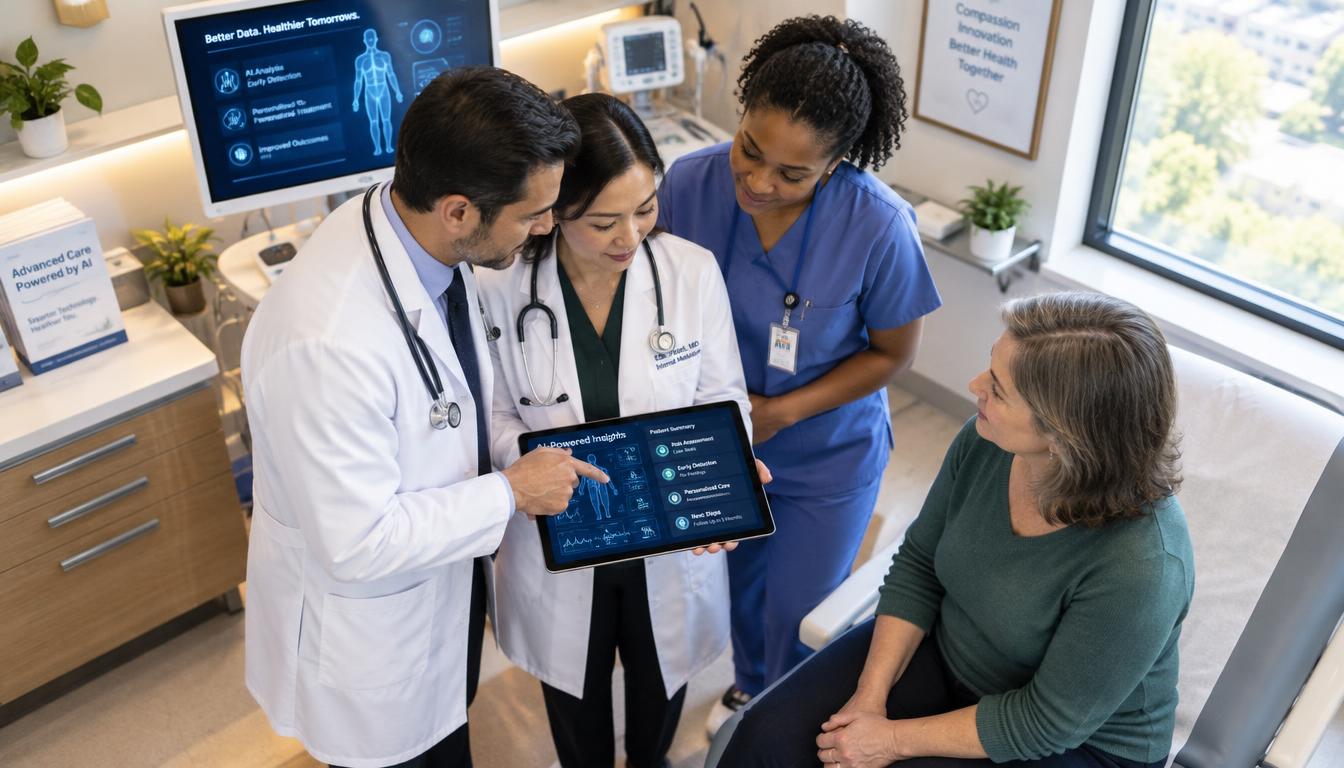
AI is already part of many healthcare workflows, but its value depends on the task it is built to support. For patients and care teams, the promise is practical help, not a cure for every problem.
A tool may save time or help staff notice a change. It can also miss important details or add work when it does not fit the care setting. Its value depends on careful checks and a clear need.
That balance matters as hospitals and clinics add new technologies. People need to know where these tools may help, what evidence can show, and what limits remain.
This overview looks at current uses, possible gains, research findings, and risks. It also considers what could change as systems become part of everyday care. The most useful question is not whether AI can do everything, but where it can help people deliver safer, more timely care.
Key Takeaways
- Healthcare AI usually supports a defined task rather than replacing a care team.
- Predictive tools estimate future events or outcomes from data.
- AI already supports some clinical, office, and research work.
- Accuracy in a study does not ensure success in every care setting.
- Privacy, bias, and safety need ongoing attention.
- Human review and clear accountability remain important.
What Does Artificial Intelligence in Healthcare Mean?
Most healthcare AI is narrow software built for a specific task, not a machine with human-like general intelligence. Predictive AI is a system that uses historical or current data to estimate a future event or outcome.
Today’s healthcare systems use task-focused artificial intelligence, not general or super AI. These labels describe different ideas, so they should not be mixed.
Two ways to classify AI
One classification describes how broad an AI system’s capability is. Artificial narrow intelligence handles a defined task, while general AI and super AI remain theoretical.
A second classification describes how a machine processes information. Reactive machines respond to current inputs, while limited-memory AI can use past data.
| Type | Plain-language description | Exists today |
|---|---|---|
| Reactive machines | Respond to current inputs without using past events | Yes |
| Limited memory | Use past data to guide a current response | Yes |
| Theory of mind | Would understand feelings, beliefs, or intentions | No, theoretical |
| Self-aware AI | Would have awareness of its own existence | No, theoretical |
These four functional types are separate from narrow, general, and super AI. The first two functional types exist, but the last two remain theoretical.
What predictive AI does
Machine learning is one way systems find patterns in data. Supervised learning uses labeled examples, such as records already marked with known outcomes.
Unsupervised learning looks for patterns in unlabeled data. Reinforcement learning improves through trial and error, using feedback about its choices.
Algorithms are the rules a system follows to process information. Their design, training data, and development choices shape what a tool can estimate.
Labels such as “general AI” describe theoretical categories, not tools routinely used in clinics.
The word intelligence can suggest human-like thought, but most software does not reason broadly or understand a patient as a person does.
Treat labels such as “general AI” as theoretical categories, not descriptions of tools routinely used in clinics.
Where Is AI Already Used in Healthcare?
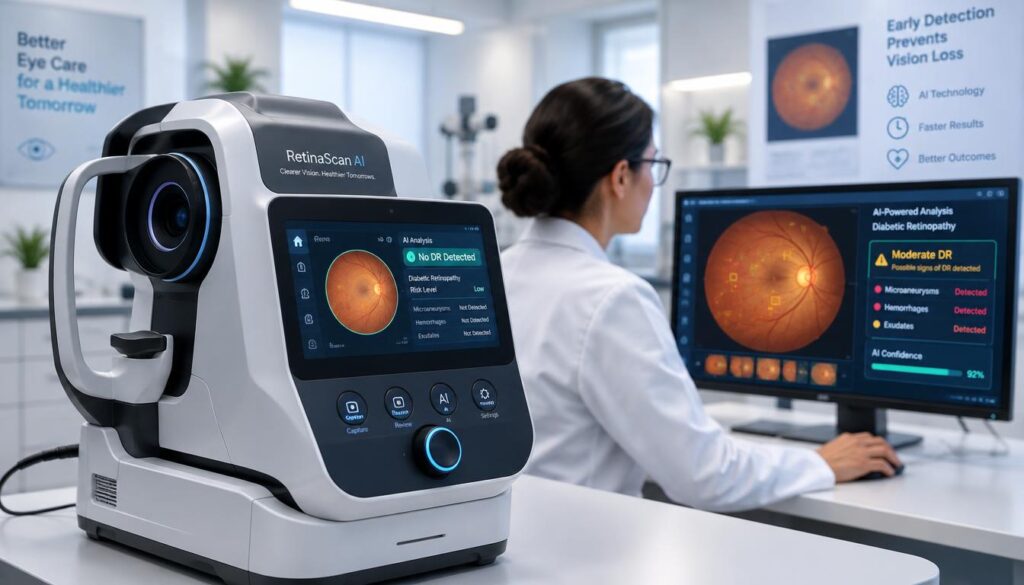
A hospital might use one AI tool to flag an inpatient’s changing risk and another to help read a retinal image. These tools work in distinct settings.
By September 2026, the FDA had authorized more than 1,600 AI-enabled medical devices for marketing in the United States. Authorization applies to a device’s intended use.
Imaging, risk prediction, and follow-up
Common uses include:
- Screening retinal images for signs of diabetic retinopathy.
- Predicting inpatient health risks or likely health trajectories.
- Identifying high-risk outpatients who may need follow-up.
- Tracking health data through wearables or remote sensors.
- Segmenting spine images with AI-assisted software.
The FDA list includes systems that detect diabetic retinopathy from retinal images. It also lists Auto-Seg, a spine auto-segmentation device with a final decision date of June 29, 2026.
FDA-described uses include earlier disease detection and diagnosis, personalized diagnostics and therapeutics, and improved device usability. More than 1,600 devices does not mean every tool suits every task.
Monitoring, documentation, and research
Remote monitoring can help care teams review changes between visits. Chatbots may support symptom intake, while natural language processing can draft clinical notes.
In research, AlphaFold predicts protein structures. That work can help researchers study biology, but it does not replace clinical judgment or prove a treatment will work.
In 2024, 86% of multi-hospital system members used predictive AI, compared with 37% of independent hospitals. Inpatient risk or trajectory prediction was the most common hospital use.
From 2023 to 2024, hospital use of predictive AI to identify high-risk outpatients for follow-up rose by 9 percentage points. Digital health tools still need a clear role.
A useful first check is whether a tool supports a defined task in the care setting where it will actually be used.
Which Benefits Can AI Bring to Patient Care?
Hospital use of predictive AI for billing and scheduling grew notably from 2023 to 2024. That growth points to a practical goal: reducing routine work.
Administrative gains matter when they return useful time to staff without creating more review work. Clinical gains depend on whether a tool helps change a sound decision.
Less administrative friction
Predictive AI use to simplify or automate billing rose by 25 percentage points from 2023 to 2024. Use for scheduling rose by 16 percentage points.
Fewer repetitive steps may help staff spend more time with patients. Faster sorting of information can also help a team find the details it needs sooner.
Those gains are not automatic. A system that sends unclear alerts or needs repeated corrections can take time away from care instead of returning it.
More timely, individualized support
Risk-based follow-up can help a team focus attention on patients who may need contact sooner. The value depends on accurate signals and a useful response.
Machine learning may also help teams weigh a person’s data when planning care. A model can support decisions, but a clinician must consider the patient’s needs and circumstances.
For people seeking 10 benefits of artificial intelligence in healthcare, the gains fit into a few groups: less repetitive work, faster information handling, focused follow-up, and more tailored support.
These are potential benefits, not ten guaranteed outcomes. A tool’s effect depends on its design, the quality of its data, and how care teams use its results.
Time saved on billing or scheduling does not prove that patient care improved. Teams need to see whether the change helps patients or supports better decisions.
A practical benefit test is whether the tool saves time without adding a new review burden to the care team.
Can AI Diagnose Diseases Better Than Doctors?
Generative AI has not been shown to outperform physicians overall, and it performed worse than expert physicians in pooled comparisons. The distinction matters.
A review of 83 studies found 52.1% overall diagnostic accuracy for generative AI. That result is not a guarantee for an individual patient.
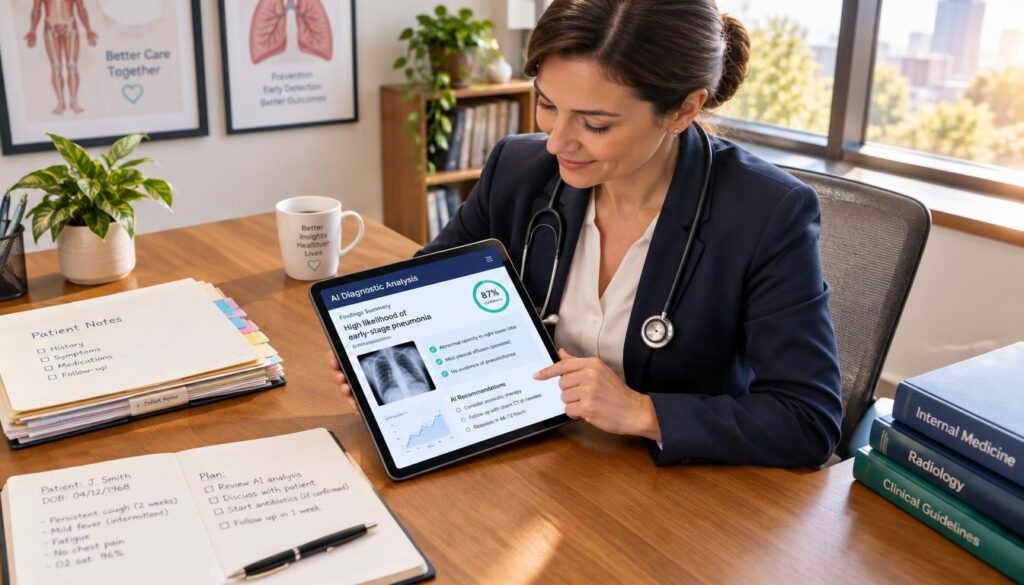
The studies were published between June 2018 and June 2024. Overall, researchers found no statistically significant difference between generative AI models and physicians.
| Comparison | Finding | Statistical result |
|---|---|---|
| Overall generative-AI diagnostic accuracy | 52.1% | 83-study review |
| Generative AI compared with physicians overall | No significant difference | p = 0.10 |
| Generative AI compared with expert physicians | Models performed worse | p = 0.007 |
The overall accuracy figure combines different study tasks and conditions. It does not measure every algorithm or every AI-enabled medical device used in medicine.
Task-specific tools may be built for a narrow purpose, while generative AI can produce broad answers from a prompt. Those types of models should not be treated as interchangeable.
A clinician must read any result alongside symptoms, medical history, and an examination. A number on its own cannot show what a patient needs.
Generative AI can produce a confident answer that still misses key facts. A patient’s age, medicines, or unusual symptoms may change the meaning of a result.
Readers should treat an AI result as decision support, not as a diagnosis to act on without clinical review.
What Risks Need to Be Managed?
A system can be accurate on one dataset and still create harm if its data, users, or clinical setting differ. Fit matters at every stage.
Responsible use requires validation for the intended task and continued review after launch. A tool can change as data and workflows change.
Privacy, bias, and explainability
Algorithmic bias can lead to uneven results when training data do not reflect the people who will use the tool. Limited transparency can make errors hard to spot.
Patient-data privacy is another concern. Teams need to know what information a tool uses, how it is protected, and who can access it.
Implementation safety matters too. A poorly timed alert or unclear result may disrupt care, even when a model performs well in a test.
A balanced discussion of the advantages and disadvantages of artificial intelligence in healthcare should weigh possible gains against these risks. A 2024 review qualitatively synthesized 44 studies on benefits and concerns.
Validation, regulation, and accountability
The FDA regulates AI-enabled medical devices under the Federal Food, Drug, and Cosmetic Act. Its risk-based approach considers intended use and technological features.
The FDA’s device list is updated from time to time and is not comprehensive. Inclusion means a device met applicable premarket requirements for its intended use, not that it fits every workflow.
In 2024, 82% of hospitals using predictive AI evaluated models for accuracy, 74% evaluated for bias, and 79% monitored them after implementation. Post-launch monitoring is part of responsible deployment.
A 2025 analysis of 105 healthcare AI studies found clinician-led studies had higher odds of reporting significant impact than studies without clinical leadership (OR = 7.793, p = 0.039).
A study on deploying artificial intelligence in healthcare should focus on whether the tool fits its users, data, and care setting. Clinician involvement can help test that fit.
Teams can use this checklist before and after launch:
- Define the tool’s intended use.
- Validate it on data relevant to its care setting.
- Assess accuracy and bias.
- Protect patient data.
- Assign clinical accountability and monitor after deployment.
FDA device management can cover development, validation, deployment, monitoring, maintenance, and modification. Before implementation, name the person responsible for reviewing failures and changing or stopping the tool.
What Will AI Change in Healthcare Next?
The near-term change is more likely to reshape specific tasks than to make clinical judgment unnecessary. That shift will depend on how well tools fit daily work.
AI’s future role depends on usable data, clear oversight, and integration into clinical information systems. A useful tool must fit the way care teams work.
Clinical information systems need to share data across tools and settings. Interoperability, or the ability of systems to exchange and use information, can shape whether AI fits a real workflow.
The potential for artificial intelligence in healthcare includes faster support for specific tasks. Its growing role is more likely to change parts of jobs than to erase whole professions automatically.
A May 2025 roundup estimated that 30% of current U.S. jobs could be automated by 2030, while 60% would have tasks significantly modified by AI.
Those estimates cover U.S. jobs across industries, not healthcare alone. They do not name healthcare jobs that will disappear or show that possible automation will cause job losses.
In clinical information systems, the future depends on workflow fit, data exchange, ongoing monitoring, and clear accountability. A new feature can add confusion when staff cannot see how its output belongs in care.
For any new tool, ask which task it changes, who checks its output, and how the system will be monitored.
That question keeps attention on the real work, not a broad promise about technology. It also gives care teams a way to discuss whether a tool helps.
Conclusion
AI’s promise in healthcare is strongest when it strengthens good care rather than standing in for clinical responsibility. A useful tool meets a specific need and stays under appropriate human oversight.
Trust grows when healthcare teams test a tool for its intended use and keep checking how it performs. Collaboration between clinicians, technical teams, and patients can help make standards practical.
Before relying on an AI tool, ask a clinician or healthcare organization how it is validated and monitored. Ask how the tool is checked, who is accountable for its use, and what happens when it is wrong.