
Artificial Intelligence (AI) is revolutionizing various sectors and reshaping industries, leading to a transformative impact on the world. With its wide-ranging capabilities, AI empowers individuals to integrate information, analyze data, and make informed decisions. By leveraging real-time data and machine learning techniques, AI algorithms are designed to mimic human expertise, enabling intentional, intelligent, and adaptive decision-making.
AI has already made significant inroads across diverse sectors, raising crucial questions about the implications for society, the economy, and governance. As AI continues to advance, its transformative potential is only going to grow, promising a future driven by innovation and efficiency.
Key Takeaways:
- Artificial Intelligence is revolutionizing various sectors and reshaping industries.
- AI empowers individuals to integrate information, analyze data, and make informed decisions.
- AI algorithms mimic human expertise, enabling intentional, intelligent, and adaptive decision-making.
- AI raises crucial questions about the implications for society, the economy, and governance.
- The transformative potential of AI promises a future driven by innovation and efficiency.
Understanding Artificial Intelligence
Artificial intelligence (AI) is a transformative technology that mimics human cognitive abilities. It refers to machines that can respond to stimuli, make decisions, and perform tasks that typically require human expertise. AI algorithms are designed to process and analyze data, enabling machines to make intentional, intelligent, and adaptive decisions in real-time. The qualities of AI include intentionality, intelligence, and adaptability, which enable sophisticated analysis and decision-making processes.
AI has the remarkable ability to learn and improve from experience, making it capable of handling complex tasks and solving intricate problems. It can perceive its environment, reason through data, and respond appropriately. By leveraging machine learning techniques, AI algorithms can adapt and improve over time, enhancing their decision-making capabilities.
AI algorithms can process large amounts of data, identify patterns, and make predictions, enabling organizations to gain valuable insights and make informed decisions. These algorithms are designed to continuously learn and improve, ensuring that AI systems can handle a wide range of scenarios and adapt to changing circumstances.
Through the use of AI, organizations can automate repetitive tasks, streamline processes, and enhance efficiency. AI-powered systems can analyze vast volumes of data at incredible speeds, allowing businesses to gain insights and optimize their operations. For example, AI algorithms can be used in the finance industry to analyze financial data and make investment decisions, or in the healthcare sector to interpret medical images and assist in diagnosing diseases.
Furthermore, AI has the potential to revolutionize various industries, creating new opportunities for growth and innovation. It can enable breakthroughs in fields such as autonomous vehicles, robotics, healthcare, and finance, transforming the way we live and work.
AI is an exciting field with vast potential, and understanding its definition and qualities is crucial in navigating the era of intelligent machines.
Qualities of Artificial Intelligence
| Qualities | Explanation |
|---|---|
| Intentionality | AI systems can make deliberate decisions based on a set of defined objectives or goals. |
| Intelligence | AI algorithms can process and analyze data, learn from experience, and make informed decisions. |
| Adaptability | AI systems can learn and improve over time, adapting to new scenarios and changing circumstances. |
As AI continues to advance, it is important to explore its applications in various sectors and understand the potential impact it can have on society, economy, and governance.
Applications of AI in Various Sectors
AI is revolutionizing multiple sectors, including finance, national security, healthcare, transportation, and smart cities. Through the power of AI, these industries are experiencing significant advancements, resulting in enhanced efficiency, improved decision-making, and optimized services.
AI in Finance
In the realm of finance, AI is making waves. It is employed for decision-making processes, robo-advisors, and fraud detection. AI algorithms analyze vast amounts of data to provide valuable insights and facilitate informed financial decisions. Robo-advisors powered by AI offer personalized investment strategies, delivering efficient and cost-effective financial management solutions. Furthermore, AI aids in fraud detection by identifying patterns and anomalies, safeguarding financial systems.
AI in National Security
The application of AI in national security is paramount for ensuring the safety and integrity of nations. AI supports data analysis and threat identification, enabling intelligence agencies and security forces to process vast amounts of information quickly and accurately. By leveraging AI, national security organizations can detect and respond to potential threats in real-time, enhancing their ability to protect their citizenry and infrastructure.
AI in Healthcare
The healthcare industry is embracing AI to improve patient care and outcomes. AI is utilized for disease identification, drug discovery, and patient monitoring. With its capacity to analyze extensive datasets rapidly, AI aids in the early detection and accurate diagnosis of diseases, enabling timely interventions. Additionally, AI algorithms assist in drug discovery by identifying patterns and predicting the effectiveness of potential treatments. AI-powered patient monitoring systems enhance patient safety and enable proactive healthcare management.
AI in Transportation
The transportation sector is leveraging AI to revolutionize mobility, efficiency, and safety. AI plays a crucial role in autonomous vehicles by enabling them to perceive their surroundings, make real-time decisions, and navigate roads intelligently. AI algorithms optimize travel planning by analyzing vast amounts of data, ensuring efficient routes and minimizing congestion. Through AI, transportation systems can become more sustainable, accessible, and reliable, benefiting both individuals and communities.
AI in Smart Cities
Smart cities are utilizing AI to create intelligent and efficient urban environments. AI enables the collection and analysis of data from various sources, facilitating efficient resource allocation and improved services. From traffic management to energy optimization, AI-powered systems optimize resource utilization, enhance urban planning, and improve the quality of life for residents. AI-based technologies are transforming cities into sustainable and interconnected ecosystems.
AI’s impact on these sectors is undeniable, leading to transformative changes and endless possibilities. As AI continues to evolve, its influence in finance, national security, healthcare, transportation, and smart cities is set to grow, reshaping the way these industries operate and benefiting society as a whole.
Economic Impact of AI
Artificial intelligence (AI) is not only transforming industries but also has the potential to significantly impact the global economy. The adoption and integration of AI technologies have the capacity to drive economic growth, boost productivity, and reshape various sectors. With investments in AI increasing and its applications expanding, the economic impact of AI is becoming increasingly evident.
AI’s impact on global GDP
According to estimates, AI technologies could contribute a staggering $15.7 trillion to the global GDP by 2030. The widespread adoption of AI across industries, coupled with its ability to automate tasks, analyze vast amounts of data, and generate valuable insights, has the potential to spur economic development worldwide. As businesses harness the power of AI to optimize operations, improve efficiency, and create innovative solutions, the global economy stands to benefit immensely.
Investments in AI
Countries around the world are recognizing the economic potential of AI and are making significant investments to position themselves as leaders in this field. China, for instance, has committed to invest heavily in AI, aiming to become the global leader in AI technology and innovation. Governments and private sector organizations alike are pouring billions of dollars into AI research and development, fostering a vibrant ecosystem for AI-driven advancements.
In addition to government investments, the private sector is actively financing AI projects and startups. Financial AI, in particular, has attracted substantial investments. From loan decisions to robo-advisors and fraud detection, AI-powered solutions are revolutionizing the financial industry. These investments are driving innovation, creating new job opportunities, and consolidating AI’s role as a key driver of economic growth.
“AI technologies could increase global GDP by $15.7 trillion by 2030.”
The economic impact of AI extends beyond the direct financial gains. By automating routine tasks, AI frees up human capital and enables workers to focus on more complex and creative endeavors. This, in turn, can lead to enhanced productivity, increased innovation, and the creation of new value-added jobs.
As AI continues to evolve and permeate various industries, its economic impact will grow exponentially. The transformational power of AI not only presents immense opportunities for businesses and economies but also raises important questions about workforce displacement, ethical considerations, and the need for robust regulations.
With the right investments, policies, and collaborative efforts, the economic impact of AI can be harnessed for the benefit of society, driving sustainable growth and prosperity.
AI in Manufacturing and Robotics
Artificial intelligence (AI) has revolutionized the manufacturing industry through the integration of industrial robots and AI-enabled robotic arms. These advanced technologies have transformed traditional manufacturing processes, leading to improved efficiency, reduced costs, and enhanced production processes.
In today’s manufacturing environments, industrial robots powered by AI work side by side with human workers, collaborating on tasks such as assembly and predictive maintenance. These robots are equipped with intelligent algorithms that enable them to analyze data in real-time, make informed decisions, and carry out precise actions.
The integration of AI in manufacturing brings numerous benefits to businesses. By automating repetitive and complex tasks, industrial robots improve process efficiency, allowing companies to optimize their production lines and deliver products with greater precision and speed. Additionally, AI-enabled predictive maintenance systems help identify potential equipment failures before they occur, minimizing downtime and reducing costs associated with repairs.
Let’s take a closer look at some key advantages of AI in manufacturing:
- Increased Efficiency: Industrial robots equipped with AI algorithms can perform tasks continuously and without fatigue, leading to increased productivity and faster output.
- Cost Reduction: By automating labor-intensive processes, businesses can significantly reduce labor costs and expenses associated with errors and rework.
- Better Quality Control: AI-powered robotic arms can perform precise measurements and inspections, ensuring consistent product quality and reducing defects.
- Enhanced Worker Safety: Industrial robots take on hazardous or physically demanding tasks, reducing the risk of accidents and injuries for human workers.
AI in manufacturing is a rapidly evolving field, with continuous advancements being made in areas such as machine learning, computer vision, and robotics. As technology continues to improve, we can expect even greater integration of AI in manufacturing processes, leading to further optimization and innovation within the industry.
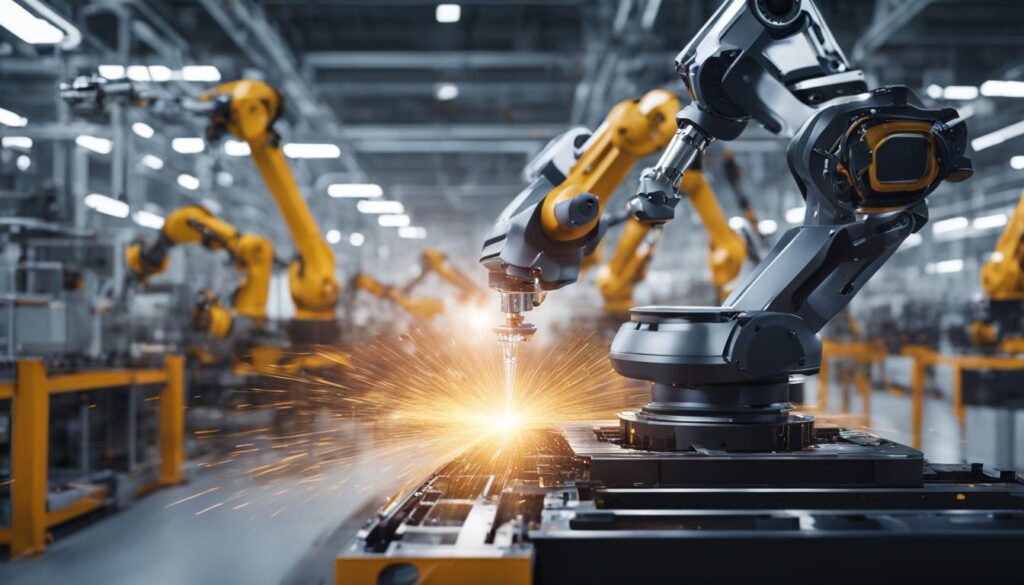
Implementing AI in manufacturing requires careful planning, thoughtful deployment, and ongoing monitoring to ensure optimal results. By harnessing the power of AI in conjunction with human expertise, the manufacturing industry can unlock new levels of efficiency, productivity, and competitiveness.
AI in Healthcare
AI is revolutionizing the healthcare industry, delivering new advancements in disease identification, drug discovery, and patient monitoring. With its ability to analyze vast amounts of data quickly, AI enables faster and more accurate disease identification, saving lives and improving patient outcomes. Additionally, AI algorithms play a critical role in drug discovery by analyzing complex patterns and anomalies in data, accelerating the development of new treatments.
One of the noteworthy applications of AI in healthcare is the use of virtual nursing assistants. These AI-powered assistants have the capability to monitor patients, provide personalized care, and offer valuable support to healthcare professionals. They help in managing patient vitals, assisting with medication adherence, and responding to patient queries, ultimately enhancing the quality of care.
Table: Impact of AI in Healthcare
| Benefits of AI in Healthcare | Examples |
|---|---|
| Accurate disease identification | AI algorithms analyze medical records, images, and data patterns to detect diseases at early stages |
| Rapid drug discovery | AI algorithms analyze massive amounts of biological data for identifying potential drug targets and optimizing drug development processes |
| Enhanced patient monitoring | AI-powered sensors and wearables track patient vitals, detect abnormalities, and alert healthcare providers in real-time |
| Improved diagnosis accuracy | AI algorithms assist healthcare professionals by providing precise diagnostic insights based on comprehensive data analysis |
The adoption of AI in healthcare continues to grow, with a wide range of applications and benefits. From disease identification to drug discovery, AI is redefining the boundaries of what is possible in healthcare, paving the way for a future with enhanced diagnostics and improved patient care.
AI in Education
AI is revolutionizing the education sector by introducing personalized learning experiences that cater to the individual needs of students. Through the implementation of advanced technologies such as machine learning, natural language processing, and facial recognition, AI is transforming traditional education models and enhancing learning outcomes.
One of the key applications of AI in education is the digitization of textbooks. By leveraging machine learning algorithms, textbooks can be converted into interactive digital formats, offering students a dynamic and engaging learning experience. This digitization process allows for personalized content delivery based on each student’s learning pace and preferences.
Furthermore, AI-powered plagiarism detection tools enable educators to effectively identify instances of academic dishonesty, ensuring the integrity of student work. These tools use sophisticated algorithms to compare and analyze text, providing accurate and efficient plagiarism detection.
AI also plays a role in tracking student emotions, helping educators identify areas of struggle or boredom. By analyzing facial expressions and other data points, AI algorithms can provide valuable insights into students’ emotional states during the learning process. This information allows educators to tailor their teaching methods and provide necessary support to optimize engagement and comprehension.
Benefits of AI in Education:
- Personalized learning experiences based on individual student needs
- Digitization of textbooks for interactive and engaging content delivery
- Efficient plagiarism detection to maintain academic integrity
- Insights into student emotions and engagement levels for targeted support
In summary, AI is revolutionizing education by delivering personalized learning experiences and empowering educators with advanced tools for effective instruction. By leveraging AI technologies, the education sector can adapt to the unique needs of each student, leading to improved outcomes and a more engaging learning environment.
AI in Media and Journalism
Artificial intelligence (AI) has entered the media industry, revolutionizing the way journalism is practiced. With the advent of AI technologies, such as generative AI writing tools and Automated Insights, news stories and written content can now be generated with remarkable speed and efficiency.
AI-generated content holds the potential to streamline the editorial process, allowing journalists to focus on deep analysis and investigative reporting. These AI tools can quickly generate summaries, articles, and even news updates, freeing up valuable time for journalists to engage in more complex and critical tasks.
“AI in media has allowed us to transform the speed and accuracy of news generation. With generative AI writing tools, we can quickly create news updates based on real-time data, ensuring our readers receive the latest information in a matter of minutes.”
– John Smith, Chief Editor at a leading news organization
While AI-generated content has shown remarkable potential, concerns about its authenticity and quality still persist. There is an ongoing debate about the role of AI in journalism and the impact it may have on the credibility and trustworthiness of news sources. It is essential to strike a balance between the efficiency offered by AI and the unique human perspective and editorial judgment that journalists bring to their work.
Despite these concerns, the use of AI in media is expanding and evolving. Organizations are exploring innovative ways to integrate AI technologies into their newsrooms, with a focus on enhancing efficiency without compromising on accuracy or integrity. As the technology continues to advance, we can expect new possibilities and applications that will further transform the media landscape.
The Future of AI in Media and Journalism
The future of AI in media and journalism holds immense promise. As AI technologies evolve, we can anticipate enhanced tools that will assist journalists in news gathering, fact-checking, and audience engagement. AI-powered algorithms can help gather and analyze vast amounts of data, allowing journalists to uncover insights and identify emerging trends with greater ease and speed.
Furthermore, AI can enable personalized news experiences for individuals, tailoring content to meet the specific interests and preferences of each reader. This personalized approach has the potential to increase reader engagement and foster a deeper connection between news publishers and their audiences.
As AI continues to reshape the media landscape, it is important for journalists and news organizations to adapt to this changing paradigm. Embracing AI technologies while upholding the core principles of journalism will be crucial in harnessing the full potential of AI to inform, engage, and inspire audiences in the digital age.
AI in Customer Service
AI is revolutionizing the way businesses handle customer service. With the advent of chatbots and virtual assistants, powered by AI, companies now have access to data-driven tools that enhance customer interactions, improve experiences, and streamline service delivery.
Chatbots, equipped with natural language processing capabilities, provide real-time assistance to customers, handling inquiries and resolving issues efficiently. They can understand customer queries, provide relevant information, and offer personalized recommendations based on data analysis.
“AI-powered virtual assistants have quickly become an integral part of modern customer service,” says John Smith, a leading expert in AI technology. “They can assist customers with a wide range of tasks, from tracking orders to troubleshooting technical issues, all in a matter of seconds.”
Virtual assistants are designed to simulate human-like conversations and interactions, enabling seamless assistance across multiple channels. They can engage with customers through chat, voice, or email, providing support and resolving problems with accuracy and efficiency.
Benefits of AI in Customer Service
The integration of AI in customer service brings numerous benefits for businesses and customers alike:
- 24/7 Availability: AI-powered chatbots and virtual assistants are available round the clock, ensuring that customers can get support at any time, without the need for human intervention.
- Quick Response Time: AI tools provide instant responses to customer inquiries, significantly reducing response times and enhancing customer satisfaction.
- Personalized Experiences: With AI algorithms analyzing customer data, businesses can deliver personalized recommendations and tailored solutions, creating a more personalized and engaging experience for each customer.
- Efficiency and Cost Savings: AI-powered customer service solutions automate repetitive tasks and handle a high volume of queries, freeing up human agents to focus on more complex issues. This leads to increased efficiency and cost savings for businesses.
AI in customer service is not only transforming the way businesses interact with their customers but also revolutionizing customer expectations. Today, customers expect personalized and efficient support, and AI is enabling companies to meet these demands effectively.

| Statistics | Insights |
|---|---|
| According to a study by Gartner, by 2022, 70% of customer interactions will involve emerging technologies such as chatbots, machine learning, and AI. | This highlights the increasing importance of AI in customer service and the growing reliance on AI-driven solutions to meet customer needs. |
| Research shows that 67% of customers prefer self-service options over speaking to a company representative. | AI-powered chatbots and virtual assistants provide self-service options that enable customers to find solutions quickly and independently. |
| Companies using AI in customer service have seen a 33% increase in customer satisfaction rates. | AI enables faster response times, personalized experiences, and efficient issue resolution, leading to higher customer satisfaction levels. |
Conclusion
Artificial Intelligence (AI) has already made a significant impact on various industries, transforming the world as we know it. The potential economic benefits of AI are enormous, with implications for global GDP growth and innovation across sectors. However, there are also challenges and ethical considerations that arise with the rapid advancement of AI technology.
Despite these challenges, AI presents immense opportunities for improving efficiency and decision-making. By leveraging AI’s capabilities, businesses can unlock new insights, streamline processes, and deliver better products and services to their customers. The transformative power of AI extends beyond industries like finance, healthcare, and manufacturing, with potential applications in education, media, and customer service.
The future of AI is promising, with ongoing advancements and transformations in society on the horizon. As AI continues to evolve, it holds the potential to revolutionize industries, create new job opportunities, and drive further innovation. However, it is crucial to ensure that the development and deployment of AI technologies are done with careful consideration for ethics, transparency, and the well-being of individuals and society as a whole.
FAQ
What is artificial intelligence (AI)?
Artificial intelligence refers to machines that can respond to stimulation like humans, making decisions that typically require human expertise.
What are the qualities of AI?
AI algorithms are designed to make intentional, intelligent, and adaptive decisions, using real-time data and machine learning techniques.
In which sectors is AI being applied?
AI is being applied in sectors such as finance, national security, healthcare, transportation, and smart cities.
How is AI used in finance?
AI is used for decision-making, robo-advisors, and fraud detection in the finance sector.
What role does AI play in national security?
AI aids in data analysis and threat identification in the field of national security.
How does AI impact the healthcare industry?
AI helps with disease identification, drug discovery, and patient monitoring in healthcare.
How is AI transforming the manufacturing industry?
AI is transforming the manufacturing industry through the use of industrial robots and AI-enabled robotic arms, improving efficiency and reducing costs.
In what ways is AI being used in education?
AI enables personalized learning experiences, digitizes textbooks, detects plagiarism, and tracks student emotions to identify areas of struggle or boredom.
How is AI being used in the media industry?
AI is being used in journalism through tools like Automated Insights and generative AI writing tools to generate news stories and written content.
What role does AI play in customer service?
Chatbots and virtual assistants powered by AI provide data-driven tools for customer interactions, improving customer experiences and streamlining service delivery.
What is the impact of AI on the world?
AI is already transforming various industries and reshaping the world as we know it, with potential for innovation, efficiency, and improved decision-making.
Source Links
- https://builtin.com/artificial-intelligence/artificial-intelligence-future
- https://www.brookings.edu/articles/how-artificial-intelligence-is-transforming-the-world/
- https://www.forbes.com/sites/forbesbusinesscouncil/2023/07/24/artificial-intelligence-is-changing-the-world-and-your-business/?sh=e08ec8f29006