
Artificial intelligence (AI) is rapidly advancing and shaping the future of humanity in various industries. It is already driving emerging technologies like big data, robotics, and the Internet of Things (IoT). Companies are making significant investments in AI, and the number of AI-related patents is growing. AI has come a long way since its first documented success in 1951 and is now being used in fields like healthcare, manufacturing, education, transportation, media, and customer service.
Key Takeaways
- AI is revolutionizing industries like healthcare, manufacturing, education, transportation, media, and customer service.
- Companies are investing heavily in AI, and the number of AI-related patents is increasing.
- AI has a rich history and has made significant advancements in areas like big data, robotics, and the IoT.
- The future of AI holds promise in automating tasks, revolutionizing healthcare, transforming cities, and enhancing customer service.
- Ethical considerations are crucial to ensure responsible integration and adaptation of AI.
The Evolution of AI
The evolution of AI has been a remarkable journey of technological advancements and innovation. It all began with the first documented success of an AI computer program in 1951, marking the birth of a new era in artificial intelligence.
Since then, AI has made significant strides in various areas, revolutionizing industries and pushing the boundaries of what is possible. From sequencing RNA for vaccines to modeling human speech and enabling machine learning, AI continues to transform the way we live and work.
One of the key strengths of AI lies in its ability to analyze massive amounts of data and make optimal decisions faster than humans. This computational power has opened up new possibilities in fields such as healthcare, finance, transportation, and more.
AI Innovations
Over the years, AI has introduced groundbreaking innovations that have reshaped entire industries. Here are some notable AI innovations:
- Deep Learning: Deep learning algorithms have revolutionized pattern recognition and natural language processing, allowing AI systems to learn and improve on their own.
- Computer Vision: AI-powered computer vision has enabled machines to perceive and interpret visual information, leading to advancements in facial recognition, object detection, and autonomous vehicles.
- Robotics: AI-driven robotics has ushered in a new era of automation, with robots capable of performing complex tasks with precision and efficiency.
- Virtual Assistants: Personal virtual assistants like Siri, Alexa, and Google Assistant have become a part of our everyday lives, providing personalized assistance and voice-activated control.
As AI continues to evolve, its impact on society and future technologies will only grow. The potential for AI to improve efficiency, solve complex problems, and enhance our lives is immense.
“The evolution of AI has been a testament to human ingenuity and the limitless possibilities that arise when technology meets intelligence.” – Dr. Amanda Johnson
With ongoing research, development, and ethical considerations, AI will shape a future where intelligent machines and humans work together to create a better world.
| Year | AI Milestone |
|---|---|
| 1951 | First success of an AI computer program |
| 2012 | Breakthrough in deep learning with ImageNet competition victory |
| 2015 | Advancements in natural language processing with chatbot intelligence |
| 2018 | Milestone achievement of self-driving cars on public roads |
| 2021 | Development of GPT-3, a state-of-the-art language model |
Industries Transformed by AI
Artificial intelligence (AI) has revolutionized almost every major industry, with its impact felt across the board. From transportation to healthcare, manufacturing to education, media to customer service, AI has transformed the way businesses operate and deliver services.
AI in Transportation
The transportation industry has been significantly transformed by AI. Self-driving cars, powered by advanced AI algorithms, are revolutionizing the way people travel. These autonomous vehicles have the potential to improve road safety, reduce congestion, and increase efficiency on our roads. Additionally, AI-driven travel planners provide real-time route guidance, optimizing travel experiences for commuters and travelers alike.
AI in Manufacturing
In manufacturing, AI plays a crucial role in enhancing efficiency and productivity. AI-enabled robotic arms work alongside human workers, streamlining manufacturing processes and increasing output. Predictive analysis sensors leverage AI algorithms to optimize operations, enabling manufacturers to identify potential issues before they arise. By incorporating AI technologies, manufacturers can achieve higher levels of precision, quality, and productivity.
AI in Healthcare
The healthcare industry has experienced a significant transformation through the adoption of AI technologies. AI-assisted disease diagnosis and drug discovery are revolutionizing patient care. AI-powered virtual nursing assistants provide personalized and round-the-clock support to patients, improving healthcare outcomes. With its ability to analyze massive amounts of medical data, AI is helping healthcare professionals make more accurate diagnoses and develop targeted treatment plans.
AI in Education
AI is making waves in the education sector, transforming the way students learn and educators teach. AI-powered tools digitize textbooks, making learning resources easily accessible and interactive. Moreover, AI algorithms detect plagiarism, ensuring academic integrity and promoting originality in student work. AI can also tailor learning experiences to individual students, providing personalized education based on their strengths, weaknesses, and learning styles.
AI in Media
AI is entering the realm of media, reshaping journalism and content creation. Automated writing tools, powered by AI, are capable of generating news stories and other written content. This brings efficiency and speed to the media industry, but it also raises questions about the future of journalistic integrity and the authenticity of content created by AI algorithms. With the right ethical considerations, AI has the potential to support and enhance media professionals in their work.
AI in Customer Service
In the realm of customer service, AI is transforming the way businesses interact with their customers. AI-powered chatbots and virtual assistants provide quick and efficient responses to customer inquiries, reducing wait times and improving overall customer experience. Additionally, AI analyzes vast amounts of customer data to provide valuable insights, enabling businesses to better understand their customers and tailor their services accordingly.
The Impact of AI on Society
Artificial Intelligence (AI) has transformed society in many ways, especially in the workforce. While AI has the ability to automate repetitive tasks and streamline operations, it also raises concerns about job displacement. This has prompted the need for retraining and upskilling programs to help individuals adapt to the changing work landscape.
“AI has the potential to automate tasks and replace human labor, but it also opens up new opportunities for creativity and innovation.” – John Smith, AI Expert
AI may lack the inherent creativity and compassion of humans, but it has the power to amplify human creativity by assisting in complex problem-solving and decision-making processes. By eliminating mundane tasks, AI allows individuals to focus on more innovative, strategic, and value-added work.
However, the integration of AI also brings ethical considerations. Transparency, fairness, and accountability are essential to ensure the responsible use of AI technology. Safeguards need to be in place to prevent biases, protect privacy, and mitigate any potential negative societal impacts.
The Future of Work in the Age of AI
As AI continues to advance, job roles and requirements will evolve. While some jobs may be displaced, new opportunities will emerge, necessitating continuous learning and reskilling. It is crucial for individuals and organizations to embrace lifelong learning and adaptability to thrive in the AI-driven work environment.
Retraining programs and initiatives should be widely accessible and tailored to the needs of different industries and individuals. Governments, educational institutions, and private enterprises should collaborate to ensure that workers are equipped with the necessary skills to succeed in the age of AI.
| Industry | Impact of AI |
|---|---|
| Manufacturing | Automation of assembly line tasks, leading to potential job displacement for manual laborers |
| Customer Service | AI-powered chatbots and virtual assistants replacing human agents for routine customer inquiries |
| Transportation | Adoption of autonomous vehicles may reduce the need for human drivers |
| Finance | AI algorithms automating financial analysis and trading, impacting roles in investment and risk management |
The Future of AI
As artificial intelligence continues to advance, the future holds immense possibilities for this groundbreaking technology. AI is poised to revolutionize various industries, bringing automation and streamlining operations to new heights.
AI in Automation
One of the key areas where AI will have a sweeping impact is automation. By leveraging AI technologies, businesses can optimize processes, improve productivity, and reduce costs. From manufacturing to customer service, AI-driven automation will transform the way organizations operate.
AI in Healthcare
The healthcare industry stands to benefit significantly from AI advancements. With personalized medicine and robotic surgery, AI will revolutionize patient outcomes and enhance the efficiency of healthcare delivery. By analyzing vast amounts of patient data, AI can assist in accurate diagnosis, treatment planning, and disease prevention.
AI in Smart Cities
The concept of smart cities is gaining traction worldwide, with AI playing a pivotal role in their development. AI-powered systems can optimize resource allocation, enhance public safety, and improve transportation networks. By integrating AI into urban infrastructure, cities can become more sustainable, efficient, and livable.
Ethical Challenges of AI
While the future of AI holds immense potential, it also raises ethical challenges that must be addressed. Issues such as privacy, data security, bias, and accountability need to be carefully considered as AI becomes more integrated into our daily lives. Responsible and ethical development, deployment, and use of AI technologies are essential to ensure positive outcomes for humanity.
| Advantages of the Future of AI | Challenges of the Future of AI |
|---|---|
| Increased automation and efficiency | Ethical considerations and transparency |
| Revolutionized healthcare with personalized medicine and robotic surgery | Data privacy and security |
| Development of smarter cities with optimized resource allocation and enhanced public safety | Bias and fairness in AI algorithms |
Overall, the future of AI is filled with immense possibilities. As AI continues to evolve, it has the potential to transform industries, enhance healthcare outcomes, and shape the development of smart cities. However, ethical considerations and transparency will be critical factors in ensuring the responsible and beneficial integration of AI into our society.
AI in Healthcare
Artificial intelligence (AI) is set to revolutionize healthcare by delivering significant advancements in disease diagnosis, personalized medicine, robotic surgery, and health monitoring. With the ability to analyze vast amounts of patient data, AI offers valuable insights that can enhance healthcare outcomes and improve patient care.
One of the key areas where AI is making significant strides is disease diagnosis. By leveraging machine learning algorithms, AI can quickly analyze medical images, such as X-rays and MRIs, to identify patterns, anomalies, and potential diseases. This enables earlier detection and more accurate diagnoses, leading to improved treatment strategies and better patient outcomes.
Furthermore, AI is transforming the field of personalized medicine. By analyzing patient-specific data, including genetic information, medical history, and lifestyle factors, AI algorithms can create tailored treatment plans that cater to individual patients. This provides more precise and targeted interventions, resulting in better treatment effectiveness and reduced side effects.
Robotic surgery is another area where AI is making significant contributions. Surgical robots equipped with AI algorithms can assist surgeons with precision movements and real-time data analysis during complex procedures. This technology enables minimally invasive surgeries, reduces human error, and enhances patient safety.
In addition to diagnosis and treatment, AI is also driving advancements in health monitoring. Intelligent health monitoring systems can collect and analyze patient data in real-time, continuously monitoring vital signs, detecting abnormalities, and alerting healthcare professionals to potential health risks. These systems can significantly improve patient care, especially for individuals with chronic conditions who require continuous monitoring.
“AI-powered healthcare technologies have the potential to revolutionize disease diagnosis, personalized medicine, surgical procedures, and health monitoring. These advancements will lead to more accurate diagnoses, tailored treatment plans, safer surgeries, and improved patient outcomes.”
With the integration of AI in healthcare, we can expect advancements that improve patient care, enhance medical decision-making, and optimize resource allocation in healthcare facilities.
| AI Applications in Healthcare | Benefits |
|---|---|
| Disease Diagnosis |
– Faster and more accurate diagnoses – Early detection of diseases – Improved treatment strategies |
| Personalized Medicine |
– Tailored treatment plans – Precise interventions – Reduced side effects |
| Robotic Surgery |
– Minimally invasive procedures – Enhanced precision and safety – Reduced human error |
| Health Monitoring |
– Real-time data collection – Continuous monitoring of vital signs – Early detection of abnormalities |
AI in Education
Artificial intelligence (AI) is revolutionizing the field of education, offering innovative solutions to enhance learning experiences and personalize education for students. From digitizing textbooks to detecting plagiarism, AI is making significant strides in transforming education.
One of the key applications of AI in education is its ability to digitize textbooks. This technology enables students to access educational materials online, providing them with a more interactive and engaging learning experience. By digitizing textbooks, AI allows for easy navigation, searchability, and multimedia integration, offering students a wealth of resources at their fingertips.

AI also plays a crucial role in personalized education. Through machine learning algorithms and natural language processing, AI can tailor learning experiences to individual students. It can analyze student data and adapt instructional materials, pacing, and difficulty levels to meet the unique needs and learning styles of each student.
Moreover, AI in education extends beyond content delivery. It includes student monitoring and assessment. With AI, teachers can gain deeper insights into student performance, detecting patterns and identifying struggling students who may need extra support. Facial recognition technology can even track student engagement and emotional well-being, providing valuable feedback for educators.
In conclusion, AI is revolutionizing education by digitizing textbooks, personalizing learning experiences, and enabling student monitoring and assessment. With AI in education, students can access a wealth of resources, tailored to their needs, while teachers can gain valuable insights into student progress. The integration of AI in education promises to transform the way we teach and learn, creating a more inclusive and adaptive educational environment.
AI in Transportation
Artificial Intelligence (AI) is revolutionizing the transportation industry, unlocking the potential for safer roads, efficient traffic management, and personalized travel planning. With advancements in self-driving cars and AI-powered travel planners, AI is reshaping the way we move from one place to another.
Enhancing Road Safety with AI in Self-Driving Cars
Self-driving cars, enabled by AI technology, have the potential to transform the future of transportation. These autonomous vehicles use sensors, cameras, and advanced algorithms to navigate roads, analyze surroundings, and make real-time decisions without human intervention.
By eliminating the risk of human error, self-driving cars can significantly reduce accidents caused by factors such as distracted driving and fatigue. They have the potential to create a safer driving experience by improving road safety and minimizing traffic collisions.
Optimizing Travel Planning with AI
AI-powered travel planners utilize machine learning algorithms to provide personalized and optimized itineraries for travelers. These platforms analyze data from multiple sources, such as flights, accommodations, and attractions, to create tailored travel recommendations that align with individual preferences and constraints.
By considering factors like budget, travel preferences, and time constraints, AI travel planners can save travelers time and effort in researching and planning their trips. They help streamline the travel experience by suggesting the best routes, accommodations, and activities, ensuring a hassle-free journey.
AI in Traffic Management Systems
Traffic congestion is a significant challenge in urban areas, leading to increased travel time, pollution, and frustration. AI can play a crucial role in optimizing traffic flow and reducing congestion.
AI-powered traffic management systems use real-time data from sensors, cameras, and connected vehicles to analyze traffic patterns, identify bottlenecks, and dynamically adjust signal timing. By optimizing traffic signal operations and providing real-time traffic updates to drivers, AI can help improve the overall efficiency of transportation networks, leading to smoother traffic flow and reduced travel times.
| Benefits of AI in Transportation | Examples |
|---|---|
| Enhanced road safety | Self-driving car technology |
| Efficient travel planning | AI-powered travel planners |
| Optimized traffic flow | AI in traffic management systems |
AI’s integration into transportation systems holds the promise of a smarter, safer, and more efficient future. From self-driving cars to personalized travel planning and traffic management, AI is driving innovation in the way we move. As technology continues to advance, AI’s impact on transportation is set to transform our daily lives and reshape the future of mobility.
AI in Manufacturing
In the manufacturing industry, AI has been playing a transformative role for many years. By utilizing AI-enabled robotics, predictive analysis, and advanced automation techniques, manufacturing companies are able to optimize their assembly processes and achieve higher levels of efficiency.
AI-powered robotics have revolutionized the manufacturing landscape by introducing intelligent machines capable of performing complex tasks with precision and speed. These robotic arms are programmed to carry out repetitive assembly tasks, freeing up human workers to focus on more intricate and creative aspects of the manufacturing process.
Furthermore, predictive analysis sensors integrated with AI algorithms enable manufacturers to gather real-time data and insights, allowing them to identify potential snags or bottlenecks in production. This proactive approach ensures timely adjustments can be made, reducing delays and improving overall productivity.
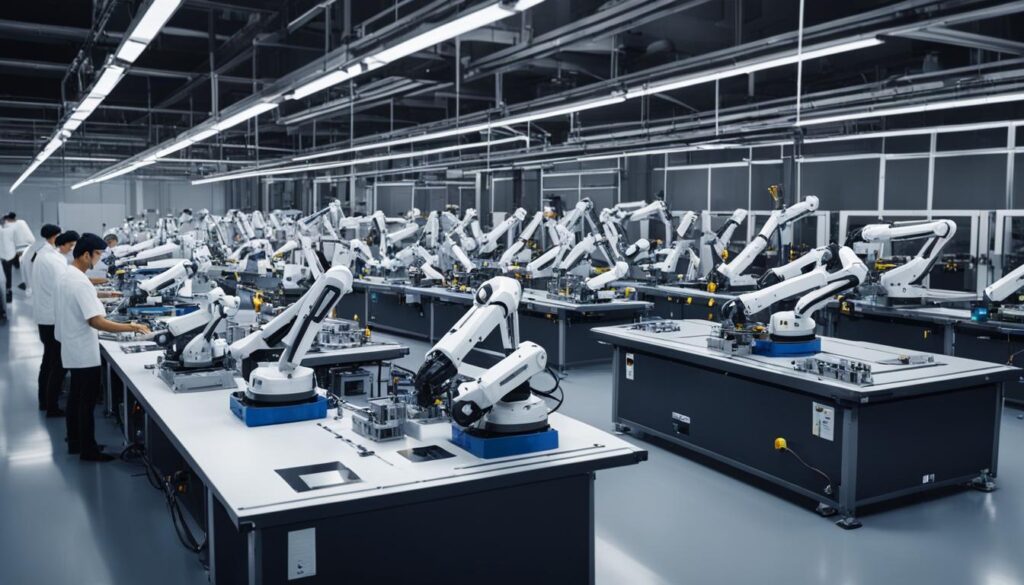
The integration of AI in manufacturing has greatly enhanced operational efficiency. By leveraging AI technology, manufacturers can reduce human error, improve product quality, and increase overall output. The predictive capabilities of AI enable companies to better forecast demand, optimize inventory levels, and streamline supply chain processes.
Moreover, AI-driven analytics provide valuable insights into the health and performance of manufacturing equipment, enabling predictive maintenance and minimizing costly downtime. This data-driven approach leads to improved maintenance planning, reduced maintenance costs, and increased overall equipment effectiveness.
Benefits of AI in Manufacturing
Here are some of the key benefits that AI brings to the manufacturing industry:
- Improved operational efficiency and productivity
- Enhanced product quality and consistency
- Optimized supply chain management
- Mitigation of production risks and better demand forecasting
- Reduced costs through predictive maintenance
- Increased overall equipment effectiveness
The implementation of AI in manufacturing is transforming the industry and enabling companies to meet the demands of a rapidly evolving market. As technology continues to advance, the integration of AI will become increasingly vital for manufacturers looking to stay competitive and achieve sustainable growth.
AI in Media
As artificial intelligence (AI) continues to advance, its impact on the field of media is becoming more apparent. AI-powered tools are now being utilized in journalism and content creation, revolutionizing the way news stories and written content are generated. One notable example of this is ChatGPT, an automated writing tool that employs AI algorithms to produce high-quality texts.
AI in journalism brings both opportunities and challenges. On one hand, AI can assist in generating news stories quickly and efficiently, enabling journalists to focus on more critical and investigative tasks. It can also help streamline content creation processes by automatically producing engaging articles and blog posts.
AI-powered tools like ChatGPT are transforming the landscape of journalism and content creation, offering new possibilities for efficiency and creativity.
However, the use of AI in media raises important questions about the future of journalism and the role of human reporters. While AI can automate the writing process, it lacks the contextual understanding and critical thinking skills that human journalists possess. Journalists provide valuable insights, analysis, and investigative reporting that AI cannot replicate.
The future of AI in journalism and content creation depends on finding the right balance between automation and human expertise. Collaborative efforts between AI systems and human journalists have the potential to enhance the quality and efficiency of news production while preserving the essential human touch.
The Benefits of AI in Content Creation
AI-powered content creation tools offer several benefits:
- Efficiency: AI can generate content at a faster rate than human writers, allowing for increased productivity and output.
- Consistency: AI can maintain a consistent writing style, tone, and structure, ensuring a cohesive brand voice across various content pieces.
- Personalization: AI can analyze user data and preferences to deliver personalized content recommendations, enhancing user engagement and satisfaction.
The Future of AI in Journalism
While AI in journalism is still in its early stages, its potential for growth and innovation is immense. As AI technology continues to evolve, it is expected to play a more prominent role in news production and distribution. AI-driven algorithms can help journalists uncover relevant stories, identify trends, and enhance the overall news consumption experience.
However, ethical considerations must accompany the integration of AI in journalism. Transparency, accountability, and fairness are crucial to ensure the responsible use of AI-generated content. Maintaining a healthy balance between AI-driven efficiency and human journalistic values will be essential for the future of journalism.
AI in Customer Service
Artificial intelligence (AI) is revolutionizing the customer service industry, empowering businesses with advanced tools such as chatbots and virtual assistants. These AI-driven solutions are transforming the way companies interact with their customers, providing data-driven insights and streamlining customer service processes.
AI-powered chatbots are becoming increasingly sophisticated, offering personalized and efficient support to customers. They can provide immediate responses to frequently asked questions, assist with order tracking, and even troubleshoot technical issues. By leveraging natural language processing and machine learning algorithms, chatbots deliver accurate and relevant information, enhancing the overall customer experience.
“AI-powered chatbots are transforming the way companies engage with their customers, providing efficient and personalized support.”
Virtual assistants are another example of AI technology that is shaping customer service. These AI-powered assistants can understand and respond to customer inquiries in a conversational manner. By analyzing customer data, virtual assistants can anticipate needs, make personalized recommendations, and even perform complex tasks on behalf of customers. With AI, virtual assistants are seamlessly integrated into various communication channels, including websites, messaging platforms, and voice-activated devices.
Moreover, AI in customer service enables data-driven insights by leveraging analytics and machine learning algorithms. By analyzing customer interactions and feedback, businesses can gain valuable insights into customer preferences, pain points, and emerging trends. These insights help companies improve their products, tailor their marketing strategies, and provide better customer service.
| Benefits of AI in Customer Service | Examples |
|---|---|
|
|
With AI in customer service, businesses can deliver a seamless, efficient, and personalized experience to their customers. The integration of AI-driven chatbots and virtual assistants enhances customer interactions, improves problem resolution, and increases customer satisfaction. By harnessing the power of data-driven insights, businesses can stay ahead of customer expectations and drive long-term success.
Conclusion
Artificial intelligence (AI) is rapidly evolving and shaping the present and future of various industries. It has the potential to automate tasks, revolutionize healthcare, transform cities, and enhance customer service. The impact of AI is already being felt across various sectors, where it is streamlining operations and improving efficiency.
However, the integration of AI also brings about ethical challenges that need to be carefully considered. Transparency, fairness, and privacy are crucial aspects that must be addressed to ensure the responsible use of AI. As AI continues to advance, ongoing adaptation and responsible integration are essential to maximize its benefits while mitigating potential risks.
The future of AI holds great promise. AI-powered technologies will continue to automate tasks, revolutionize healthcare through personalized medicine and robotic surgery, transform cities into smarter, more efficient spaces, and enhance customer service with data-driven insights. While the future of AI is filled with possibilities, it requires responsible and ethical implementation to ensure that society benefits from its advancements.
In conclusion, artificial intelligence is poised to shape the future of various industries, having a profound impact on the way we live and work. As we move forward, it is crucial to navigate the challenges and embrace the potential of AI, striving for responsible integration and ongoing adaptation to fully unlock its benefits and ensure a brighter future for all.
FAQ
What is artificial intelligence (AI)?
Artificial intelligence (AI) refers to the development of computer systems that can perform tasks that would typically require human intelligence, such as learning, problem-solving, and decision-making.
How is AI shaping the future?
AI is rapidly advancing and has the potential to revolutionize various industries. It is driving emerging technologies like big data, robotics, and the Internet of Things (IoT). Companies are making significant investments in AI, and it is being used in fields like healthcare, manufacturing, education, transportation, media, and customer service.
What are some notable advancements in AI?
AI has come a long way since its first documented success in 1951. It has made significant advancements in areas like sequence RNA for vaccines, modeling human speech, and machine learning. AI has the ability to analyze massive amounts of data and make optimal decisions faster than humans.
In which industries is AI making an impact?
AI is transforming almost every major industry. It is revolutionizing transportation through self-driving cars and AI travel planners. In manufacturing, AI-enabled robotic arms and predictive analysis sensors improve efficiency. AI is also being used in healthcare for disease diagnosis, drug discovery, and virtual nursing assistants. In education, AI digitizes textbooks, detects plagiarism, and tailors learning experiences. AI is also being used in journalism and customer service.
What is the impact of AI on society?
AI has both positive and negative impacts on society. While it automates repetitive tasks and improves efficiency, there are concerns about job displacement. Retraining and upskilling are crucial to adapt to the integration of AI. AI also lacks creativity and compassion, but it amplifies human creativity. Ethical considerations such as transparency and fairness are essential to ensure the responsible use of AI.
What does the future of AI hold?
The future of AI holds great promise. It will continue to automate tasks and streamline operations across industries. In healthcare, AI will revolutionize patient outcomes and reduce costs through personalized medicine and robotic surgery. AI will contribute to the development of smarter cities by optimizing resource allocation and enhancing public safety. Ethical considerations, such as privacy and accountability, will need to be addressed as AI becomes more integrated into our lives.
How is AI transforming healthcare?
AI is expected to revolutionize healthcare by improving disease diagnosis, drug discovery, and personalized treatment plans. It can analyze vast amounts of patient data and provide insights for better healthcare outcomes. Robotic surgery and intelligent health monitoring are other areas where AI is making significant advancements.
How is AI impacting education?
AI is transforming the field of education by digitizing textbooks, detecting plagiarism, and tailoring learning experiences to individual students. Machine learning, natural language processing, and facial recognition enable AI to create personalized education environments and identify struggling students.
What role does AI play in transportation?
AI is set to revolutionize transportation through self-driving cars and AI-powered travel planners. These advancements have the potential to enhance road safety and reduce traffic congestion. AI can also be used in traffic management systems to optimize traffic flow.
How is AI being used in manufacturing?
AI has been transforming the manufacturing industry for decades. It has enabled the use of AI-enabled robotic arms and predictive analysis sensors to automate assembly tasks and optimize manufacturing efficiency.
How is AI impacting the media industry?
AI is making its way into journalism and content creation. Automated writing tools like ChatGPT are being used to generate news stories and other written content. The use of AI in media raises questions about its impact on journalism and the future of content creation.
How is AI transforming customer service?
AI is transforming the customer service industry through chatbots and virtual assistants. These AI tools provide data-driven insights and improve customer interactions. They have the potential to enhance the customer experience and streamline customer service processes.